That Early Fall Furnace 'Boom' Is a Mechanical Warning, Not a Quirk
Before the first true frost arrives in early fall (September), many homeowners turn on their thermostats for a test run, completely unaware of the hidden danger of ignoring a weak furnace ignitor before winter hits. You might hear the blower motor engage, followed by a tense pause, and then a sudden, startling "boom" or a series of rapid clicks echoing through the ductwork. Most people assume this is simply the sound of an aging heating system waking up from its long summer dormancy. They write it off as a harmless quirk, expecting the noise to fade as the season progresses. The reality is far more serious: that percussive sound is a definitive mechanical warning sign that your system is struggling to achieve safe combustion.
If you are hearing strange noises or delayed ignition during startup, our professional heating services team can diagnose the underlying mechanical issue before it escalates into a complete breakdown.
To understand why this sound happens, it helps to look at the exact sequence of events that should occur when your thermostat calls for heat. A modern high-efficiency furnace does not use a standing pilot light that burns constantly. Instead, it relies on an electronic component called a hot surface ignitor to light the burner. When this component begins to fail, the entire sequence is thrown out of sync. The resulting "boom" is not the sound of metal expanding or ductwork shifting; it is the sound of a small, uncontrolled gas explosion inside your combustion chamber. Ignoring this symptom during the mild transitional weeks guarantees a severe, potentially dangerous failure later in the season.
• Thermostat Call — Normal Operation: Draft inducer motor starts smoothly with a low hum. — Warning Signs of Failure: Grinding or rattling from the inducer motor assembly.
• Ignition Sequence — Normal Operation: Ignitor glows brightly within seconds; gas valve opens. — Warning Signs of Failure: Persistent clicking; ignitor glows dimly or takes too long to heat up.
• Burner Lighting — Normal Operation: A soft "whoosh" sound as the gas ignites instantly. — Warning Signs of Failure: A loud "boom" or physical shuddering of the furnace cabinet.
• Blower Engagement — Normal Operation: Warm air flows steadily through the vents after a brief delay. — Warning Signs of Failure: Cold air blows for several minutes before turning lukewarm.
The critical takeaway: A furnace that bangs, booms, or clicks repeatedly is actively failing. Catching this issue in early fall allows you to address a minor component degradation before the extreme cold arrives and the system is forced to run continuously.
Understanding the Role of Your Hot Surface Ignitor
The hot surface ignitor (HSI) is one of the hardest-working components inside a modern heating system. Located directly in the path of the gas burners, its sole job is to reach a temperature high enough to ignite the fuel mixture safely and instantly. When functioning correctly, it operates flawlessly behind the scenes, ensuring your home stays warm without any dramatic noises or safety risks. If you are scheduling a furnace repair service in Yardley, our technicians will almost always evaluate this critical part first when diagnosing startup noises.
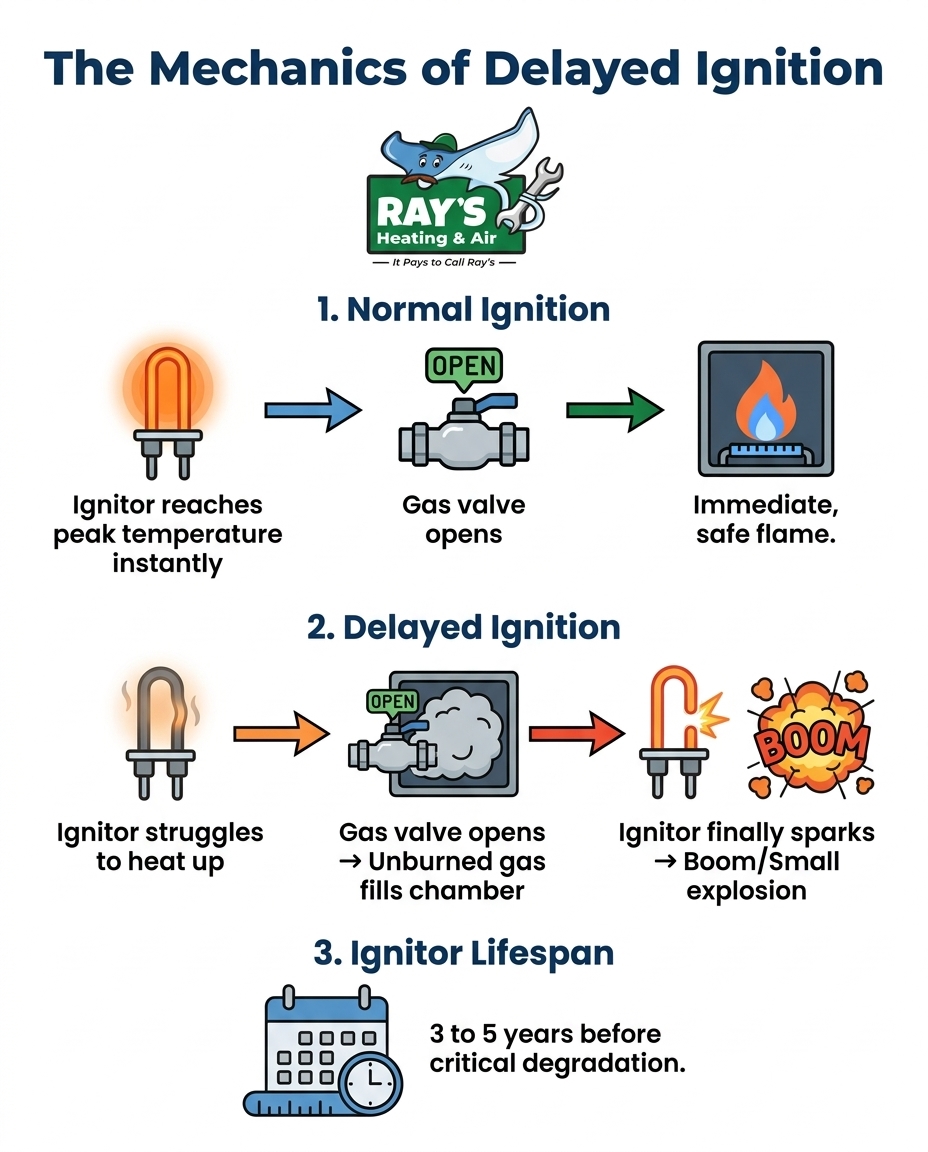
Most hot surface ignitors are manufactured from silicon carbide or silicon nitride. These highly specialized materials are chosen for their ability to conduct electricity and heat up to extreme temperatures—often exceeding 2,500 degrees Fahrenheit—in a matter of seconds. When the furnace control board receives a signal from the thermostat, it sends line voltage directly to the ignitor. The electrical resistance of the material causes it to glow white-hot. Only when the ignitor reaches its peak temperature does the control board signal the gas valve to open, allowing fuel to flow over the glowing element and ignite.
However, these components are essentially wear-and-tear parts. They have a finite functional lifespan, typically ranging from 3 to 5 years for standard silicon carbide models. Every time the furnace cycles on and off, the ignitor undergoes massive thermal expansion and contraction. Over thousands of cycles, this takes a toll on the material's structural integrity and electrical properties.
How Silicon Carbide Degrades Over Time
The degradation of an ignitor is a microscopic process with macroscopic consequences. As the silicon carbide expands during heating and contracts during cooling, microscopic stress fractures begin to form across its surface. These micro-cracks alter the way electricity flows through the component.
• Increased Electrical Resistance: As the material degrades, its resistance (measured in ohms) increases. The higher the resistance, the harder it is for the electrical current to generate the necessary heat.
• Slower Heating Times: A brand-new ignitor might reach 2,500 degrees in three seconds. A degraded ignitor might take eight to ten seconds to reach only 1,800 degrees.
• Visual Deception: A failing ignitor will often still glow bright orange or red. Visual inspection alone is not enough to confirm it is reaching the proper ignition temperature, which is why our technicians rely on multimeters to measure resistance.
This slow degradation is exactly why pre-season checks are so vital. The ignitor doesn't usually fail all at once; it weakens gradually, setting the stage for a dangerous operational hazard.
The Mechanics of Delayed Ignition and Dangerous Gas Buildup
The "boom" you hear in early fall (September) is the direct result of a phenomenon known in the HVAC industry as delayed ignition. It is a specific mechanical failure chain that occurs when the degradation of the hot surface ignitor finally outpaces the timing of the gas valve.
The Problem: During a standard heating cycle, timing is everything. The control board is programmed with a strict sequence. It sends power to the ignitor, waits a predetermined number of seconds for the element to get hot, and then opens the gas valve. The expectation is that the ignitor is already hot enough to ignite the gas the millisecond it arrives.
The Cause: When the ignitor is weak due to age and micro-cracks, it takes much longer to heat up. However, the control board does not know the ignitor is struggling. It still opens the gas valve exactly on schedule. Because the ignitor is not yet hot enough to light the fuel, raw, unburned gas begins to flood the combustion chamber. This gas rapidly accumulates, filling the enclosed space. Seconds later, the struggling ignitor finally crosses the temperature threshold required for combustion.
The Solution: The only way to stop this dangerous sequence is to have a professional replace the weakened ignitor and recalibrate the system to ensure the gas valve and ignition source are perfectly synchronized once again.
Why the 'Boom' Cannot Be Ignored
When the delayed ignitor finally lights the accumulated gas, it doesn't just light a small stream of fuel—it ignites a large volume of gas all at once. This creates a miniature explosion inside the furnace.
1. The Percussive Force: The "boom" is the acoustic shockwave of that sudden ignition. It rattles the furnace cabinet and sends a physical jolt through your ductwork.
2. Heat Exchanger Strain: Your heat exchanger is a series of metal tubes designed to safely transfer heat to your air supply while keeping toxic combustion gases contained. The repeated explosive force of delayed ignition slams against the walls of the heat exchanger, significantly increasing the risk of structural cracks.
3. Carbon Monoxide Risk: If the heat exchanger cracks from the repeated percussive stress, deadly carbon monoxide gas can leak directly into your home's breathing air.
Standard HVAC safety guidelines classify delayed ignition as a serious operational hazard. It is not a condition that will stabilize or improve; it will only grow more violent as the ignitor continues to weaken.
Why Rapid Temperature Drops Make Pre-Season Diagnostics Crucial
The climate in Yardley PA presents a unique challenge for aging heating equipment. In our years of serving the local community, our team at Ray's Heating & Air has seen how our crisp, mild autumns can suddenly transition into freezing winters almost overnight. This transitional weather actually masks the severity of a failing ignitor, lulling homeowners into a false sense of security.
During the mild weeks of fall, your furnace may only cycle on a few times a night to take the chill out of the air. The weak ignitor manages to light the gas—albeit with a loud boom—and the house warms up. Because the system isn't running constantly, the component gets ample time to cool down between cycles, and the homeowner assumes the system is functioning "well enough." If you reside in the Bucks County HVAC service area, we highly recommend using this mild period as the absolute best time to schedule diagnostic testing.
The Danger of the Deep Freeze: Once extreme cold sets in, the operational dynamics change entirely. The furnace is no longer cycling on a few times a night; it is running constantly, cycling on and off dozens of times a day to fight back the freezing temperatures. This puts maximum thermal strain on an already failing ignitor. The micro-cracks expand, the electrical resistance spikes, and the fragile silicon carbide is pushed past its breaking point.
A system failure during a sudden cold snap creates an immediate home freezing hazard. Pipes are at risk of bursting, indoor temperatures plummet rapidly, and the safety of your household is compromised. Using the transitional weather window to run test cycles, listen for abnormalities, and bring in a professional ensures that your system is mechanically sound before the heavy lifting of winter begins.
The Inevitable Mid-Winter Midnight No-Heat Emergency
The ultimate consequence of ignoring delayed ignition in early fall (September) is not just a louder "boom"—it is a complete and total system failure at the worst possible moment. An ignitor on the brink of failure will inevitably snap or burn out completely. Because furnaces work their hardest during the coldest, darkest hours of the night, this is exactly when the component is most likely to fail.
One local homeowner we recently helped experienced this exact scenario when their heat stopped working in the middle of the night during a severe winter cold snap. They called our emergency line, and our team at Ray's Heating & Air scheduled rapid service to replace the failed heating equipment, restoring comfort to their freezing house. While rapid emergency response is invaluable, the reality of a midnight no-heat situation is incredibly stressful. You wake up to a freezing house, worry about the plumbing in the walls, and scramble to find space heaters while waiting for an emergency dispatch.
Contrast the stress of an emergency failure with the controlled, scheduled replacement of a weak ignitor in the fall. When you work with one of the best HVAC companies in Yardley proactively, the repair is handled on your schedule, in daylight, before the house ever gets cold. This specific mid-winter emergency is entirely preventable by simply paying attention to the early warning signs and taking action.
How Professional Early-Season Interventions Prevent Total Failure
When a furnace ignitor weakens, the right next step is always a professional diagnostic. Working with gas valves, high-voltage control boards, and combustion components requires a licensed professional. Attempting to clean or replace a hot surface ignitor yourself is highly dangerous and can result in gas leaks, electrical shorts, or the destruction of the fragile new component.
As the proactive local experts who prevent midnight emergencies, our team at Ray's Heating & Air utilizes a comprehensive diagnostic protocol to ensure your system is genuinely ready for winter. When we perform a professional furnace tune-up, it goes far beyond just changing the filter. Here is what our professional early-season intervention entails:
• Precision Ohms Testing: Our technicians use a multimeter to measure the exact electrical resistance of the hot surface ignitor. Manufacturer specifications dictate a very narrow acceptable range. If the resistance is too high, the part is condemned and replaced before it can fail.
• Burner Assembly Cleaning: Soot, dust, and rust can accumulate on the burners over the summer. We safely clean the assembly to ensure the gas flows evenly across the ignitor for a smooth, quiet light-off.
• Gas Pressure Calibration: If the gas pressure is too high or too low coming from the valve, it can exacerbate ignition problems. Our professionals measure the manifold pressure using specialized manometers and adjust it to exact factory specifications.
• Flame Sensor Polishing: The flame sensor works in tandem with the ignitor. If it gets dirty, it may shut the system down even if the ignitor is working perfectly. Polishing this rod is a standard part of our diagnostic process.
Framing proactive replacement as a standard, cost-effective protocol ensures uninterrupted winter comfort and protects the expensive internal components of your furnace from the violent shockwaves of delayed ignition.
Frequently Asked Questions About Furnace Ignitors and Noises
Why does my furnace make a loud boom when it turns on?
A loud boom when your furnace turns on is typically caused by delayed ignition. This happens when the hot surface ignitor is weak and takes too long to heat up, allowing unburned gas to build up inside the combustion chamber. When the ignitor finally reaches the necessary temperature, it ignites the large pocket of accumulated gas all at once, creating a small explosion and a percussive "boom." This is a serious mechanical issue that requires immediate professional attention.
What are the signs of a failing furnace ignitor?
The most common signs of a failing furnace ignitor include delayed ignition (a boom or bang on startup), the furnace blowing cold air, or the system rapidly clicking without producing heat. You might also notice the system short-cycling, where it turns on and off repeatedly without warming the house. A technician can confirm a failing ignitor by measuring its electrical resistance; if the ohms reading is outside the manufacturer's specified range, the component is severely degraded.
Is delayed ignition dangerous?
Yes, delayed ignition is dangerous and should never be ignored. The repeated percussive force of the small gas explosions can severely damage the furnace's heat exchanger over time. If the heat exchanger cracks, toxic combustion gases, including deadly carbon monoxide, can leak directly into your home's air supply. It also increases the risk of a total system failure during extreme cold weather.
Can a furnace run with a weak ignitor?
A furnace can technically run with a weak ignitor for a short period, but it will operate unsafely and inefficiently. The weak ignitor will continue to cause delayed ignition and gas buildup every time the system cycles on. Eventually, the fragile silicon carbide material will crack or burn out completely, resulting in a total loss of heat. It is always safer to replace a weak ignitor proactively before it fails entirely.
How often should a hot surface ignitor be replaced?
A standard silicon carbide hot surface ignitor typically lasts between 3 to 5 years, depending on how often the furnace runs and the overall condition of the system. Upgraded silicon nitride ignitors can last significantly longer, often up to 7 to 10 years. Routine professional maintenance in early fall (September) allows a technician to test the ignitor's resistance annually and replace it right at the end of its safe functional lifespan.
Protect Your Home Before the Deep Freeze Arrives
Hearing a loud "boom" or persistent clicking from your heating system is a definitive sign of dangerous gas buildup and a failing hot surface ignitor. While it might be tempting to ignore the noise as long as the house eventually warms up, doing so puts your heat exchanger at risk and practically guarantees a total breakdown when the weather in Yardley PA turns severely cold.
At Ray's Heating & Air, we know there is immense peace of mind that comes from knowing your heating system is mechanically sound and capable of handling the most extreme winter temperatures safely. Don't wait for a complete failure to leave your family shivering in the middle of the night. Schedule a professional diagnostic assessment with our team today to replace weakened components, ensure safe combustion, and secure reliable warmth for the entire season.
Recent Posts