Waking Up to the Heat: When Your System Fails Overnight
You wake up at 2 a.m. feeling like you are wrapped in a heavy blanket, only to realize the air coming from your vents has completely stopped. At Ray's Heating & Air, we know that navigating emergency HVAC service when your system fails overnight can feel overwhelming when the house is rapidly heating up and your family is trying to sleep. The immediate disorientation quickly gives way to a pressing decision: do you pick up the phone and call for an emergency dispatch right now, or can the house hold its temperature safely until standard business hours resume?
During a late August heatwave, as families transition back to school, this situation becomes significantly more stressful. Our technicians know firsthand how the high humidity of a late-summer night in the Yardley area means the indoor environment will not just stall at a slightly warm temperature; the air quickly becomes thick, stagnant, and deeply uncomfortable. Having a clear, step-by-step action plan prevents middle-of-the-night panic and helps you make the smartest choice for your home's climate system. For comprehensive property care and related climate solutions, explore our heating services and cooling expertise to keep your home comfortable year-round.
Understanding the triage process can save you from unnecessary discomfort and anxiety. By knowing exactly what to check, what to avoid, and how professional dispatch teams handle overnight crises, you can regain control of the situation even when your air conditioner unexpectedly shuts down.
Is It a True Emergency? Triage Criteria for Homeowners
The first step in managing an overnight breakdown is distinguishing between a minor comfort inconvenience and a genuine health and safety risk. Homeowners often struggle to evaluate whether a midnight AC failure warrants waking up a technician or if the repair can wait for the morning route. The answer largely depends on your home's specific conditions, the current weather, and who is living inside the house.
We frequently see this in our service calls. For instance, our team recently helped a Yardley homeowner during a severe late-summer heat wave when their system suffered a blown compressor overnight. Because of the extreme conditions, we dispatched a technician immediately to service the required components and perform essential maintenance, getting the system back online safely. This highlights how extreme outdoor temperatures directly influence the urgency of a repair in Yardley PA.
Assessing the Health and Safety Risks
To determine if you need immediate AC repair services, you must evaluate how quickly the indoor environment is deteriorating. Stagnant, humid air severely exacerbates the heat index indoors, making the air feel significantly hotter than the thermostat reads.
• Indoor temperature rising rapidly above 80°F, high humidity — Risk Level: High Risk — Recommended Action: Call for 24-hour emergency dispatch immediately.
• Infants, elderly, or medically vulnerable individuals in the home — Risk Level: High Risk — Recommended Action: Do not wait. Request priority overnight service.
• Outdoor temperatures dropping to a comfortable mid-70s overnight — Risk Level: Moderate Risk — Recommended Action: Open windows, use fans, and schedule a first-call morning appointment.
• System making loud electrical buzzing or burning smells — Risk Level: Severe Risk — Recommended Action: Shut off power at the breaker and call immediately.
If your home includes vulnerable household members—such as infants, elderly relatives, or anyone with respiratory or cardiovascular conditions—an overnight AC failure is almost always a true emergency. The human body struggles to regulate its core temperature when sleeping in environments with high heat and high humidity, making rapid repair a medical necessity rather than just a luxury.
Immediate Safe Steps to Take Before Calling
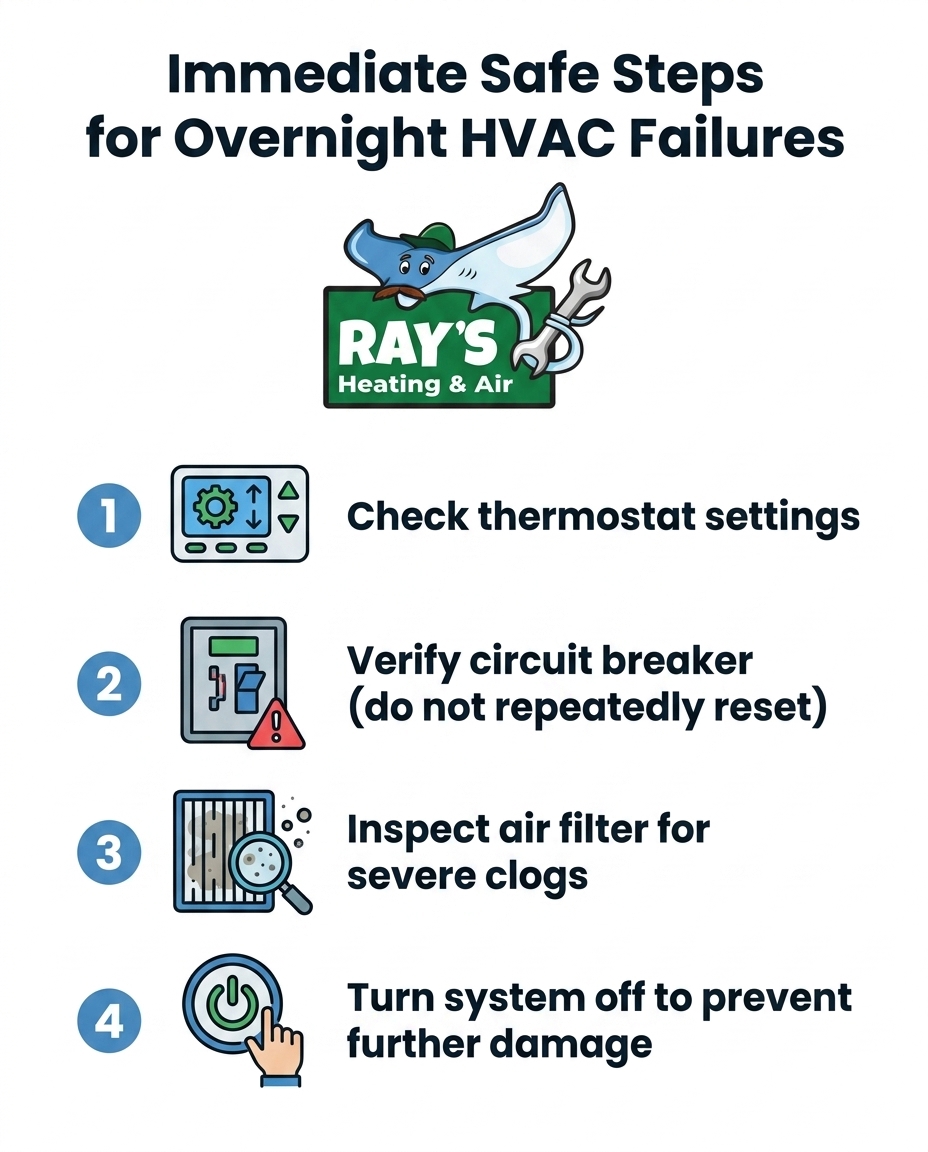
Before you pick up the phone to request an emergency dispatch from our team during a late August heatwave, we recommend performing several safe, non-technical checks. Sometimes, what appears to be a catastrophic mechanical failure is actually a simple issue that can be resolved without a late-night service fee. However, you must prioritize safety and avoid any intrusive DIY diagnostics.
1. Check the thermostat settings: In our years of late-night service calls, we've found it is surprisingly common to discover that a family member accidentally bumped the thermostat, switched it from "Cool" to "Heat," or turned the fan to the "Off" position. Verify that the screen is active, the batteries are not dead, and the cooling setpoint is lower than the current room temperature.
2. Verify the circuit breaker: Locate your home's main electrical panel and check if the breaker labeled for the air conditioner or air handler has tripped. If it has flipped to the middle or "Off" position, you can safely reset it once. Critical warning: Do not repeatedly reset a tripping breaker. If it trips a second time immediately, this indicates a dangerous electrical short or a grounded compressor. Leave it off and call a professional.
3. Inspect the air filter for severe clogs: A completely blocked air filter restricts airflow so severely that the evaporator coil can freeze solid, causing the system to shut down to protect itself. If the filter looks like a thick mat of gray dust, pull it out. If you see ice forming on the copper lines near the indoor unit, a clogged filter is likely the culprit.
4. Turn the system completely off: If the AC is running but blowing warm air, or making a strange noise without cooling, turn the system completely off at the thermostat. Allowing a malfunctioning system to run continuously can cause a minor electrical issue to destroy the compressor, turning a basic repair into a massive replacement expense. Turn it off to prevent further mechanical damage while waiting for a professional.
Safe Home Stabilization Tactics for High Humidity Nights
When you have confirmed that the system is down and you are waiting for a technician to arrive, your next priority is stabilizing the indoor environment. The humid subtropical summer characteristics of Yardley PA mean that when cooling systems fail, it is not just the heat that causes distress—it is the rapid accumulation of indoor moisture. High humidity prevents sweat from evaporating off your skin, making a 78-degree room feel suffocating.
Create mechanical cross-ventilation: Utilize all available ceiling fans and portable oscillating fans to keep the air moving. Moving air creates a wind-chill effect on the skin, which can make the room feel up to four degrees cooler than the actual ambient temperature. Position box fans in hallways to push stagnant air out of bedrooms.
Monitor the outdoor dew point: A common mistake we see Yardley homeowners make during an overnight breakdown is immediately throwing open all the windows. If the outdoor humidity and temperature are higher than the indoor conditions, opening windows will actually pull thick, wet air into your home, accelerating the discomfort. Keep windows closed and blinds drawn if the outside air feels heavier than the air inside.
Eliminate internal heat loads: Avoid using any heat-generating appliances while the AC is down. Do not run the dryer, do not use the oven, and turn off incandescent lights. Even a running television or desktop computer generates a surprising amount of ambient heat in a closed room.
Avoid dangerous DIY interventions: Our licensed professionals strictly advise against any DIY electrical or refrigerant work. Attempting to bypass a contactor, splice wires, or handle refrigerant without proper licensing is incredibly dangerous and can result in severe injury or permanent property damage. Let the fans do the work while you wait for a certified professional.
Behind the Scenes: The 24-Hour Dispatch Process
Waiting for a technician in the dark during a late August heatwave can induce a lot of anxiety. Demystifying the overnight emergency call process helps highlight the transparent communication that reputable service providers use to protect your peace of mind. Knowing exactly what happens after you dial the phone makes the wait much more manageable.
The moment you call the 24-hour dispatch line, a live representative answers to document your exact symptoms. They will ask a series of triage questions to evaluate the safety of your home and determine the immediate risk level. This information is instantly relayed to the on-call technician, initiating a communication loop that keeps you informed every step of the way.
At Ray's Heating & Air, our 24-hour emergency availability focuses heavily on transparent communication about what to expect after hours. The on-call technician will typically call you back directly to provide a realistic arrival window based on their current location and the severity of other overnight calls. This prevents you from sitting by the window wondering if help is actually on the way.
Professional teams are fully equipped to handle urgent 24-hour emergency AC service calls efficiently, arriving with fully stocked trucks to handle common late-night failures. For instance, our dispatch team received an urgent call late last summer when a customer's aging AC unit completely failed overnight. Our technician arrived promptly, assessed the old unit, discussed replacement options transparently, and installed a new unit the very same day. Whether you need immediate stabilization or comprehensive HVAC services in Doylestown and surrounding areas, the overnight dispatch process is designed to act fast without sacrificing diagnostic accuracy.
Common Culprits Behind Late-Summer Overnight Breakdowns
Why do air conditioners seem to fail exactly when you need them most? In our experience servicing Bucks County, the reality is that late-summer overnight breakdowns are rarely sudden; they are usually the final result of weeks or months of continuous operation strain during a late August heatwave. Understanding these common culprits helps explain why your system gave up at 2 a.m.
Electrical component fatigue: Months of relentless cycling take a heavy toll on electrical parts like capacitors and contactors. The capacitor acts as a massive battery that gives the compressor the jolt of energy it needs to start. After a long summer of starting and stopping dozens of times a day, the capacitor degrades. When it finally fails, the compressor cannot start, and the system blows warm air.
Neglected maintenance and frozen coils: If a system has not been tuned up, small issues compound. A slightly dirty filter combined with a minor refrigerant leak causes the evaporator coil's temperature to drop below freezing. Condensation turns to ice, eventually encasing the entire indoor unit in a block of solid ice. This blocks all airflow and forces the system to shut down.
Short-cycling strain: During peak heat periods, an oversized or severely stressed AC may turn on and off rapidly—a process called short-cycling. This prevents the system from properly dehumidifying the air and puts immense wear on the compressor motor until the internal thermal overload switch trips in the middle of the night.
The end-of-season cooling failures our technicians see in late August are distinctly different from the issues encountered during other seasons. While summer failures are largely heat-stress and airflow related, you can learn more about seasonal contrasts by reading our guide on handling HVAC emergencies during harsh winters. In both seasons, proactive maintenance is the only proven way to prevent the midnight panic of a dead system.
Restoring Your Comfort Safely and Promptly
When the unexpected happens and your home begins to heat up in the middle of the night, the most important thing you can do is stay calm and follow a safe, structured approach. By checking your thermostat, verifying the breaker, and utilizing fans for cross-ventilation, you can safely stabilize your home in Yardley PA without resorting to dangerous DIY repairs.
Understanding the triage criteria and the transparent dispatch process empowers you to make confident decisions about when to call for immediate help. You do not have to endure a sweltering, sleepless night. Rely on transparent, professional help to restore your home's climate safely. If your system has failed and you need fast, reliable intervention, reach out to our team for emergency HVAC repair in Yardley to get your home back to a cool, comfortable sanctuary.
Frequently Asked Questions
Is a broken AC considered an emergency?
Yes, a broken AC is considered a true emergency if the indoor temperature is rising rapidly and vulnerable individuals—such as infants, the elderly, or those with medical conditions—are in the home. High indoor heat and stagnant humidity can quickly create unsafe living conditions. If the failure is accompanied by burning smells or sparking electrical components, you should shut off the power and call for emergency dispatch immediately.
What should I do if my AC stops working at night?
The first step is to safely check your thermostat settings and verify that your circuit breaker has not tripped. If the breaker is fine and the filter is not severely clogged, turn the system completely off at the thermostat to prevent further mechanical damage to the compressor. Once the system is off, utilize portable fans to keep air moving and contact a 24-hour dispatch service like ours at Ray's Heating & Air for professional guidance.
Can I sleep in a house with no AC?
You can sleep in a house without AC if the indoor temperature remains at a safe, tolerable level and you have adequate cross-ventilation. However, during severe summer heatwaves, indoor temperatures can quickly climb to dangerous levels that prevent the human body from regulating its core temperature. If the house feels suffocating and fans are not providing relief, it is safer to seek emergency repairs or alternative accommodations.
How do you survive a night without AC in the summer?
Surviving a night without AC requires strict management of your home's airflow and internal heat sources. Keep windows closed if the outside air is hotter and more humid than the inside air, and use multiple fans to create a wind-chill effect on your skin. Avoid using any heat-generating appliances like ovens, dryers, or large electronics, and stay hydrated with cool water while waiting for a technician.
What constitutes an HVAC emergency in high humidity?
An HVAC emergency in high humidity occurs when the cooling system fails and the indoor air becomes so saturated with moisture that sweat cannot evaporate from the skin, drastically increasing the heat index. This environment accelerates heat exhaustion and makes breathing difficult for those with respiratory issues. In humid subtropical climates, restoring the system's dehumidification capability is just as urgent as lowering the ambient temperature.
Recent Posts