The Hidden Heating Challenge of Doylestown Sunroom Conversions
When tackling the challenge of Sizing a Mini-Split for Your Doylestown Sunroom Before Winter Arrives, it is crucial to understand that nearly 80% of the heat in a standard sunroom escapes directly through the glass during the coldest months. If you are planning on using your converted three-season room year-round, you are facing a significant thermal hurdle. Homeowners often underestimate the massive heating load required to keep these glass-heavy spaces comfortable during harsh Pennsylvania winters. You might think adding a small heater will do the trick, but the reality of heat loss in these rooms demands a much more calculated approach.
The decision you make during the September pre-heating season dictates whether your sunroom becomes a cozy winter retreat or an abandoned, freezing storage space by January. Achieving a usable year-round environment requires moving far beyond basic square-footage estimates. To get this right, you need to explore dedicated heating solutions that account for the unique architectural challenges of your home. Sizing a mini-split for a sunroom is not a guessing game; it is a precise science.
When you transition a room from a seasonal porch to a permanent living space, the structural dynamics change completely. Traditional interior rooms benefit from insulated walls, interior doors, and shared heat from adjacent spaces. A sunroom, on the other hand, is essentially a glass box jutting out into the elements. The cold air surrounds it on three sides, and often from above and below. Understanding this fundamental difference is the first step toward reclaiming your space.
Why Standard BTU Calculators Fail for Glass-Heavy Rooms
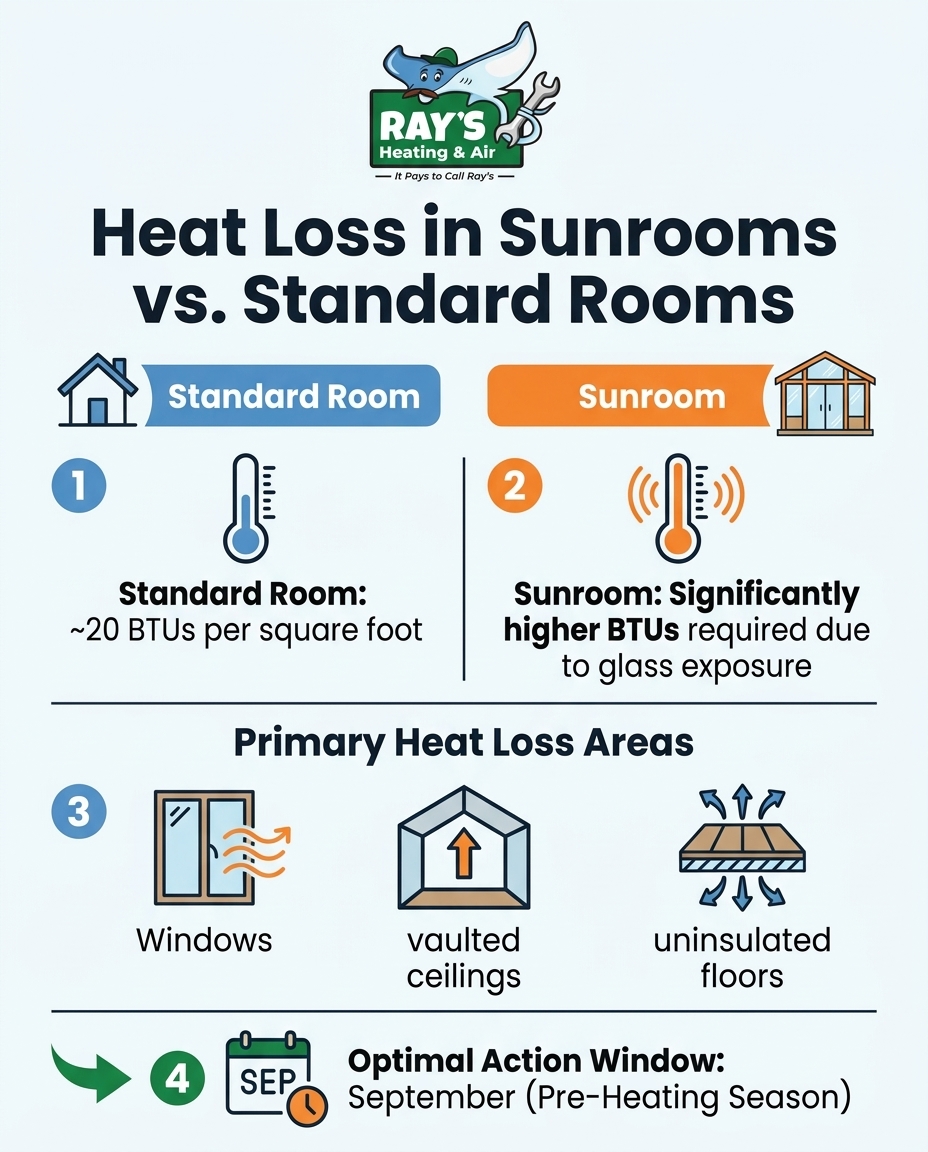
If you search online for how to size a mini-split, you will quickly find generic calculators telling you to measure the length and width of the room. For standard interior rooms, these tools typically recommend about 20 British Thermal Units (BTUs) per square foot. This rule of thumb works perfectly fine for a bedroom with standard drywall, proper fiberglass insulation, and one or two standard windows. However, applying this basic formula to a sunroom is a guaranteed path to a freezing space.
Sunrooms demand significantly higher BTUs due to the glaring lack of traditional wall insulation and the incredibly high surface area of glass. Glass offers virtually zero resistance to heat transfer compared to an insulated stud wall. At Ray's Heating & Air, our team frequently sees the consequences of relying on generic online calculators that do not account for regional temperature drops in Doylestown and Bucks County: homeowners inevitably end up with a severely undersized unit.
An undersized mini-split will run continuously, struggling to keep up with the rapid heat loss. It will never actually reach your set temperature on a cold day. This constant operation leads to skyrocketing energy bills and premature wear and tear on the compressor, eventually resulting in the need for premature heating repair in Doylestown. You end up paying more in electricity while still shivering under a blanket.
The Impact of Glass on Heat Retention
To understand why sunrooms bleed heat so rapidly, you have to look at how building materials are rated. Insulation is measured by its R-value—the higher the number, the better it resists heat flow.
• Standard Insulated Walls: A typical modern exterior wall carries an R-value between R-13 and R-21.
• Single-Pane Windows: Older sunroom glass often has an R-value of less than R-1.
• Double-Pane Windows: Even high-quality, modern double-pane glass only achieves an R-value of around R-2 to R-3.
This means heat moves through your sunroom windows up to ten times faster than it moves through a standard wall. Furthermore, many sunrooms feature vaulted ceilings or skylights, which drastically increase the total volume of air that needs to be heated. Heat rises, pooling at the top of that vaulted ceiling, leaving the living area near the floor cold unless the system has the power to properly circulate and condition the entire volume of air.
Combating Thermal Bridging in Bucks County Architecture
Beyond the sheer volume of glass, there is a structural phenomenon that silently drains heat from your sunroom: thermal bridging. Thermal bridging occurs when heat bypasses your insulation by traveling through highly conductive structural frames. In many older sunroom additions, the glass is held in place by aluminum framing. Aluminum is an excellent conductor of heat. Even if you have high-quality glass, the metal frame acts as a highway, pulling the warmth straight out of your room and into the freezing winter air.
This issue is especially prevalent given the architectural quirks of historic and mid-century homes in the region. In our years of servicing homes throughout the area, we often encounter sunrooms in Doylestown and Bucks County that were added onto existing stone or brick facades decades ago. The intersection where the glass addition meets the original masonry often lacks proper thermal breaks. When Doylestown experiences sub-freezing January and February nights, that stone acts like a giant ice block, cooling the air inside the sunroom rapidly.
These structural realities drastically alter the baseline requirements for a mini-split system. You are not just heating the air; you are constantly fighting the structural heat bleed. Evaluating these unique architectural challenges is a major factor when determining the best HVAC systems for Bucks County's historic homes and their modern additions.
Fortunately, modern HVAC technology is designed to overcome these historical building challenges. By utilizing advanced sensors and variable-speed compressors, the right mini-split can detect rapid temperature drops caused by thermal bridging and adjust its output dynamically. This ensures the room stays at a consistent temperature, even when the structural framing is actively working against it.
The Role of Hyper-Heating Technology in Sub-Freezing Temperatures
Knowing how many BTUs your sunroom needs is only half the equation; you also need a system capable of actually delivering those BTUs when the weather turns brutal. Traditional heat pumps lose their heating capacity as the outdoor temperature drops. A standard unit rated for 12,000 BTUs might only produce 6,000 BTUs when the outside air hits 20 degrees Fahrenheit. This is exactly when your sunroom needs maximum heat.
This is where hyper-heating, or cold-climate heat pump technology, becomes non-negotiable for Pennsylvania winters. Unlike older models, cold-climate heat pumps utilize advanced inverter-driven compressors. These compressors can ramp up their speed to extract ambient heat from the outdoor air even when it feels freezing outside. According to U.S. Department of Energy (DOE) and ENERGY STAR guidelines, these specialized systems are engineered to operate efficiently in northern climates.
The defining feature of a cold-climate heat pump is its ability to maintain 100% of its rated heating capacity even when outdoor temperatures drop well below freezing. Some advanced models continue to provide reliable heat down to negative 13 degrees Fahrenheit. If you install a standard heat pump in your sunroom, it will fall behind the moment a deep freeze hits.
Selecting the right technology is just as important as selecting the right BTU size during the September pre-heating season. Our technicians always stress that you need a system that does not just look good on paper at 45 degrees, but one that actually performs when the snow starts falling. The inverter technology also means the system runs quietly and efficiently, gently modulating the temperature rather than blasting hot air and abruptly shutting off.
What a Professional Heat Load Calculation Actually Entails
Because generic calculators and guesswork fail so spectacularly in glass-heavy rooms, the only reliable method is a professional heat load calculation, commonly known as a Manual J calculation. This is a rigorous mathematical assessment of your specific space. At Ray's Heating & Air, our deep local expertise in Bucks County home architecture ensures residents get custom-sized heating solutions based on hard data, rather than one-size-fits-all estimates that leave you cold.
One local homeowner recently faced a similar analytical crossroads with a 60-year-old HVAC system that could no longer be repaired. One of our technicians sat down with them, breaking down the exact difficulties, long-term operational costs, and the clear benefits of a calculated replacement versus patching up a failing unit. That same level of rigorous, transparent assessment is exactly what a sunroom conversion requires before you invest in equipment.
Here is what a professional actually measures when sizing a mini-split for your sunroom:
1. Window Specifics: We do not just measure the square footage of the glass. We assess the U-value (how well it insulates) and the Solar Heat Gain Coefficient (SHGC) of the specific panes installed in your room.
2. Volume and Elevation: We calculate the exact cubic volume of the air, factoring in vaulted ceilings, skylights, and the height of the room.
3. Directional Sun Exposure: A sunroom facing south will receive passive solar heat during the day, while a north-facing room will remain entirely shaded and significantly colder.
4. Insulation and Foundation: We inspect whether the sunroom sits on an insulated concrete slab, a wood deck structure, or an uninsulated crawlspace, as floors are a massive source of heat loss.
5. Integration with the Primary Home: We evaluate how the sunroom connects to the rest of the house. If doors are left open, an undersized sunroom unit might try to heat the adjacent living room, overworking the system entirely.
This process customizes the system design to ensure energy efficiency and consistent comfort. It dictates not just the size of the unit, but where the indoor air handler should be mounted to provide optimal airflow across the coldest glass surfaces. Remember, load calculations and system design require a licensed professional to ensure safety, proper electrical sizing, and strict warranty compliance. For comprehensive assessments, you can always rely on our Doylestown HVAC services.
Securing Your Sunroom's Comfort Before the First Major Freeze
Timing your sunroom upgrade is critical. Early fall—specifically the September pre-heating season—is the optimal window to assess heating loads and install supplementary systems. The weather is still mild enough that you are not in an emergency situation, giving you the time to make a calculated, well-researched decision.
Waiting until winter arrives carries significant risks. At Ray's Heating & Air, we often see the consequences of delayed decisions. During a recent 100-degree summer heat wave, one homeowner had to rapidly replace two failing heat pumps. While our technicians provided clear product information and successfully installed the new units to resolve the emergency, forced replacements during extreme weather carry unnecessary stress. The winter equivalent is waiting until your sunroom is completely unusable before calling for an installation. By then, scheduling availability tightens, and you miss out on enjoying the space during the holidays.
Being proactive also gives you time to explore financial incentives. Generic energy rebates or federal tax credits may apply to qualifying high-efficiency heat pump installations. While you should always verify current programs and eligibility with a tax professional or your local utility provider, these incentives are designed to make high-efficiency, cold-climate technology more accessible.
Schedule your assessment now. By securing the installation in early fall, you guarantee that your sunroom is fully conditioned, tested, and ready for peak winter use, holiday gatherings, and quiet snowy mornings.
Frequently Asked Questions About Sunroom Heating
Why does my sunroom need a larger mini-split than a standard room?
Your sunroom needs a larger mini-split because glass provides almost no insulation compared to a standard drywall and fiberglass wall. The massive surface area of windows allows heat to escape rapidly into the cold air. To maintain a comfortable temperature, the mini-split must generate significantly more BTUs to offset this constant, rapid heat loss.
Can a mini-split heat an uninsulated sunroom in winter?
Yes, a mini-split can heat an uninsulated sunroom, provided you select a cold-climate (hyper-heating) model and size it correctly. However, because the room lacks insulation, the system will need to be substantially larger than standard estimates suggest. It will also run more frequently to combat the constant heat loss through the floor and glass.
How many BTUs do I need to heat a sunroom?
There is no single answer, as sunroom BTU requirements vary wildly based on glass type, ceiling height, and floor insulation. While a standard interior room might need 20 BTUs per square foot, a sunroom in Doylestown / Bucks County often requires double or triple that amount. Only a professional Manual J load calculation can determine the exact capacity your specific room requires.
Why does my sunroom get so cold in the winter?
Sunrooms get exceptionally cold because they are structurally exposed to the elements on three sides, and often lack insulated floors or ceilings. Furthermore, single or standard double-pane glass allows winter temperatures to penetrate the room easily. Without a dedicated, high-capacity heating source, the room quickly equalizes with the freezing outdoor air.
What is thermal bridging and how does it affect my Pennsylvania sunroom?
Thermal bridging happens when heat travels through highly conductive building materials, bypassing your insulation entirely. In Pennsylvania sunrooms, this often occurs through aluminum window frames or where the glass addition meets an old, uninsulated stone exterior wall. This process literally pulls the warmth out of your room, requiring a more robust heating system to compensate.
Are cold-climate heat pumps necessary for Bucks County three-season rooms?
Yes, cold-climate heat pumps are highly recommended for transforming a three-season room into a year-round space in Bucks County. Standard heat pumps lose their heating power when temperatures drop below freezing. Cold-climate models use advanced inverter technology to maintain 100% of their heating capacity even on the coldest winter nights.
Partner with a Local Expert for Precise Sunroom Heating
Transforming a freezing glass box into a comfortable, year-round living space requires more than just buying a heater off the shelf. It requires specialized load calculations that account for the massive thermal loss of glass walls, uninsulated floors, and thermal bridging. Relying on generic square-footage estimates will only leave you frustrated and cold when the harsh weather arrives.
Navigating the specific architectural quirks and deep freezes of Doylestown and Bucks County demands genuine local expertise. You need a system designed for your exact space, utilizing cold-climate technology that will not quit when you need it most. Do not wait until the glass freezes over. Contact the team at Ray's Heating & Air to schedule a professional assessment today, determine the correct BTU capacity for your sunroom, and enjoy a warm, inviting space all winter long.
Recent Posts