Is Waking Up to a Cold House at 2 AM a Real Emergency?
Are you lying awake wondering exactly what constitutes a true heating emergency in the middle of the night, or is your system just experiencing a minor seasonal glitch? Waking up to a freezing home during an unpredictable mid-fall night is incredibly stressful. You are suddenly forced to make a decision while half-asleep: do you need to dial an emergency hotline right now, or is it safe to grab an extra blanket and wait for normal business hours? Understanding the difference between a dangerous mechanical failure and a simple operational hiccup is the key to protecting your home without unnecessary panic.
During the initial October heating-startup phase, our team at Ray's Heating & Air frequently sees systems that have sat idle for months experience minor issues as they kick back into gear. However, underlying safety hazards can also present themselves during this crucial transition period. Whether you need comprehensive heating services or targeted furnace repair in Yardley, knowing how to read your system's symptoms will guide your next steps. By following the clear, symptom-based triage approach we recommend to all our Bucks County customers, you can ease your anxiety, ensure your household's safety, and make the right call for your home.
Red Alert: Signs You Need Immediate 24-Hour Assistance
Certain symptoms are non-negotiable safety hazards. If you notice any of the following warning signs, do not wait until morning. In our years of providing emergency HVAC support to Yardley PA homes, we always advise that these indicators point to immediate risks to your property or your health, requiring professional intervention right away.
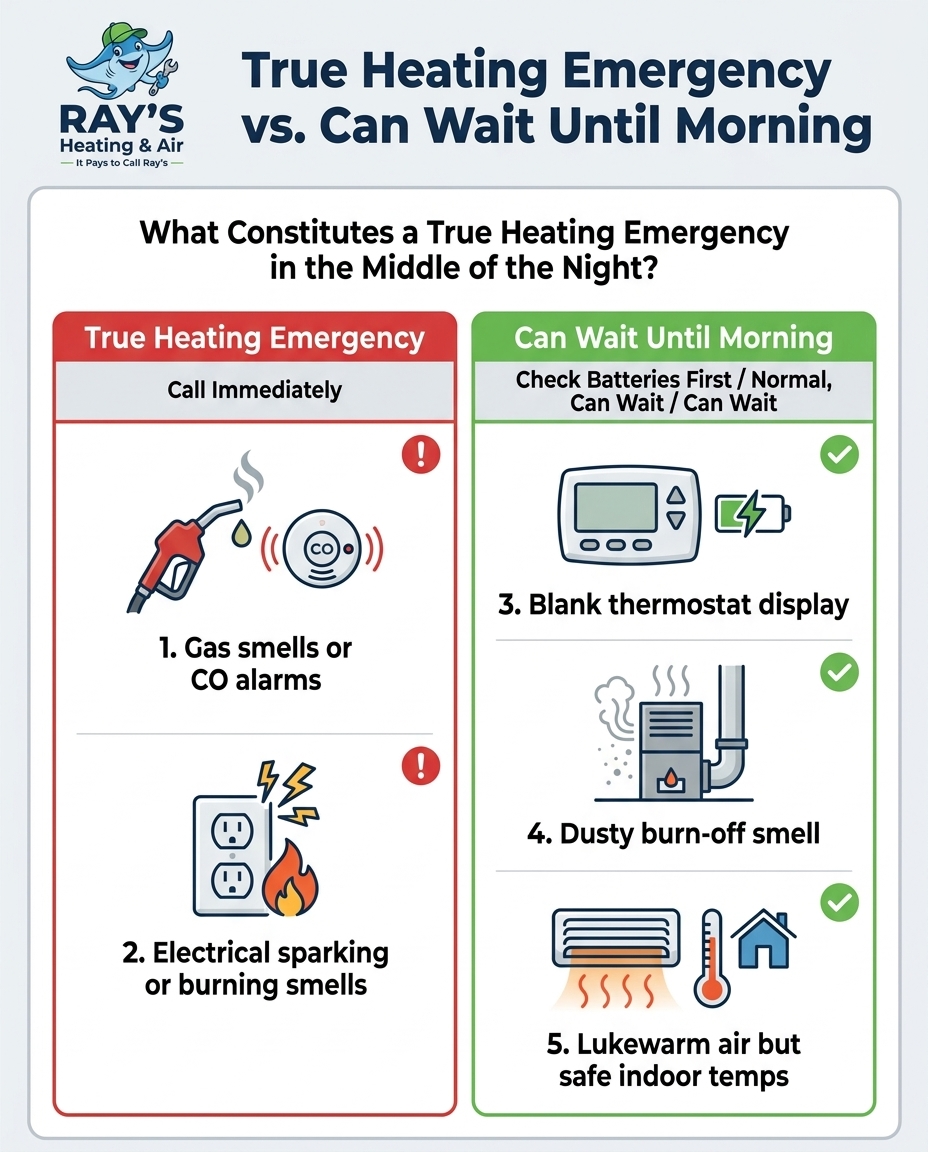
• Strong smell of gas or rotten eggs: Natural gas is odorless, but utility companies add a chemical called mercaptan to give it a distinct rotten egg smell. If you detect this odor near your furnace or throughout your home, evacuate immediately. Do not turn on lights, do not use your cell phone inside, and call your gas provider or emergency services from safely outside. Never wait until morning to address a suspected gas leak.
• Suspected carbon monoxide risks: Carbon monoxide (CO) is a colorless, odorless gas that poses a severe health risk. The danger of CO exposure increases significantly during the initial fall months when systems turn on for the first time and cracked heat exchangers or blocked flues are first exposed. If your CO detectors sound an alarm, or if household members suddenly experience unexplained headaches, dizziness, or nausea, evacuate the home and call for emergency assistance.
• Electrical burning smells or visible sparking: A faint dusty smell is normal, but the sharp, acrid scent of burning plastic, melting wire insulation, or ozone is a massive red flag. If you see visible sparks, smoke, or smell an electrical fire near your heating unit, turn off the system immediately at the thermostat and the main breaker panel, then call for emergency repair.
• Loud, sudden banging or booming noises: While minor clicks and hums are standard operation, a violent boom when the system kicks on often indicates delayed ignition. This happens when gas builds up in the combustion chamber before finally igniting with a small explosion. Over time, this can crack the heat exchanger. Severe grinding or metal-on-metal screeching also indicates a catastrophic mechanical failure, such as a detached blower wheel, which requires immediate shutdown.
Common Fall Heating Glitches That Can Safely Wait Until Morning
Not every bump in the night requires an immediate dispatch. During the October heating-startup season, many homeowners experience alarming but harmless symptoms. At Ray's Heating & Air, we routinely help residents screen out these non-emergencies over the phone, saving you the stress and expense of an unnecessary after-hours call. Here are the common glitches we see that can safely wait for daylight.
The Dusty Burn-Off Smell
When you first fire up your heating system after months of summer inactivity, a distinct dusty or slightly burning smell often fills the house. This is completely normal. Over the summer, dust, pet dander, and airborne particles settle on the heat exchanger and burner components. When the furnace turns on, these particles safely burn off. The smell should dissipate within a few hours. As long as it does not smell like melting plastic or electrical wires, you can safely go back to sleep.
System Blowing Lukewarm Air
If your vents are pushing out air that feels room temperature or slightly cool, your system is definitely struggling, but it is rarely a safety hazard. This can happen due to a dirty flame sensor, a malfunctioning heat pump defrost cycle, or an issue with the staging sequence. While it is uncomfortable, as long as the indoor temperature remains at a safe level, this is a repair that can be scheduled for the following morning.
Minor Rattling or Whistling Noises
Strange noises can be unsettling in a quiet house, but minor rattling or high-pitched whistling usually points to airflow restrictions rather than imminent danger. Whistling often occurs when a clogged air filter forces the blower motor to pull air through tiny gaps in the filter housing. A loose cabinet door can cause a metallic rattle. If the heat is still running and the noise isn't violent, you can safely wait to have a technician inspect it during normal hours.
Blank Thermostat Display
A completely blank thermostat is one of the most common reasons homeowners panic in the middle of the night. In many cases, the heating system itself is perfectly fine, but the thermostat has lost power. Before assuming the furnace is dead, check the thermostat. This is frequently a simple power issue that you can resolve yourself without needing a technician at 2 AM.
The 2 AM Heating-Startup Triage Checklist
Before you pick up the phone, there are a few safe, non-DIY checks you can perform. This October heating-startup checklist helps you verify basic operational issues, ensuring you don't call a technician out for a simple oversight.
• Check the thermostat settings and batteries: Verify that the system is actually set to "Heat" and that the setpoint is higher than the current room temperature. If the screen is blank or flashing a low-battery warning, replace the batteries. The average lifespan of a standard thermostat battery is roughly one year, making early fall a prime time for sudden failures.
• Inspect the main breaker box: A power surge or an overloaded circuit can cause the furnace's dedicated breaker to trip. Open your electrical panel and look for a switch that has moved to the middle, neutral position. You can firmly push it to "Off" and then back to "On" to reset it. However, if the breaker trips a second time immediately after resetting, stop. Do not repeatedly flip it, as this indicates a serious electrical short that requires a professional.
• Examine the system's air filter: A completely clogged filter restricts airflow so severely that the furnace's internal safety limit switch will trip, shutting the system down to prevent overheating. If you ran your AC heavily over the summer and forgot to change the filter before the heating-startup, it may be choked with debris. Slide it out; if you cannot see light through it, replace it.
• Make sure all vents and registers are open: Walk through the house and ensure that heavy furniture, rugs, or drapes have not been pushed over the return and supply vents. Closing too many vents in unused rooms actually increases static pressure inside the ductwork, which can cause the system to short-cycle and shut down prematurely.
Boiler vs. Furnace Failures: Does the System Type Matter?
The type of heating system in your home dictates the kinds of emergencies you might face. Forced-air furnaces and hydronic boilers operate on entirely different mechanical principles, meaning their warning signs present differently. Knowing what system you have in your Bucks County / Yardley PA home is the first step in assessing the danger.
Furnaces heat air and push it through ductwork. They primarily present emergencies through combustion issues (gas smells, delayed ignition booms), electrical component failures, or a complete loss of airflow due to blower motor failure. Because they rely on moving large volumes of air, a furnace failure often results in a rapid drop in indoor temperature.
Boilers, on the other hand, heat water and pump it through radiators or baseboards. They have unique warning signs. A sudden, significant pool of water forming around the base of the boiler is a clear sign of a cracked heat exchanger, a failed expansion tank, or a blown pressure relief valve. While a minor drip might wait until morning, a heavy leak requires immediate boiler repair to prevent severe water damage to your home.
• Gurgling or bubbling noises in pipes — System Type: Boiler — Urgency Level: Low (Air in lines, safe until morning)
• Sudden heavy water pooling at base — System Type: Boiler — Urgency Level: High (Risk of water damage, call now)
• Violent boom when starting up — System Type: Furnace — Urgency Level: High (Delayed ignition, turn off and call)
• Brief dusty burning smell on first startup — System Type: Furnace / Boiler — Urgency Level: Low (Normal seasonal burn-off)
If you hear gurgling noises in a boiler system, it usually indicates air trapped in the hydronic lines. While this is annoying and reduces heating efficiency, it is generally safe until morning. However, if the pressure valves are leaking heavily or the unit is completely unresponsive despite having power, professional intervention is necessary.
Assessing Indoor Temperature Drops and Household Risks
Even if the mechanical failure itself isn't inherently dangerous (like a dead blower motor), the resulting drop in indoor temperature can quickly become a health and safety hazard. The urgency of your situation depends heavily on the weather outside and who is living inside the home.
Evaluate the Indoor Temperature
A house that retains 60 degrees is certainly uncomfortable, but it is generally safe for healthy adults for a few hours. You can layer clothing, use extra blankets, and comfortably wait for a morning appointment. However, if the indoor temperature drops below 50 degrees, the environment begins to pose a structural and health risk. At this stage, the thermal mass of your home is compromised, and the situation warrants an immediate call for fast furnace repair in Bucks County.
Consider Vulnerable Residents
The threshold for what constitutes an emergency changes drastically depending on your household members. Infants, the elderly, or individuals with compromised immune systems or chronic illnesses cannot regulate their body temperatures as effectively as healthy adults. If your home has vulnerable residents, a sudden loss of heat during an October heating-startup failure is an emergency, regardless of whether the indoor temperature has hit 50 degrees yet.
Understanding Pipe Freezing Risks in Mid-Fall
Many homeowners panic about frozen pipes the moment the heat goes out. While this is a very real and severe threat during deep-winter cold snaps in January and February, the early fall climate context is different. Nighttime temperatures in Bucks County during mid-fall often drop sharply into the upper 30s or low 40s. This causes significant discomfort and alters the urgency of a repair, but it rarely causes immediate pipe bursts. Homes retain enough residual heat during these milder daytime/nighttime swings to protect internal plumbing for a night. Focus your urgency on household comfort and mechanical safety rather than pipe freezing during the fall.
What to Expect When You Make the After-Hours Call
Making an emergency call at 2 AM can feel intimidating, but knowing the process helps lower homeowner anxiety. A reliable emergency service will answer the phone promptly, even in the dead of night. You won't be left leaving voicemails in a void. The dispatcher or on-call technician will immediately ask symptom-based questions to confirm the safety of the household. They will ask about smells, sounds, and the current indoor temperature to triage the situation accurately.
If the situation is deemed safe to wait, they may schedule a priority first-thing-in-the-morning visit to resolve the issue efficiently, saving you emergency dispatch fees while ensuring you are the first stop of the day. For example, one of our local customers recently experienced a complete heating failure in the middle of a cold night; our team called back within minutes and, after verifying the home was safe, scheduled a priority visit for the very next day, ultimately replacing the failing system efficiently and painlessly. Highlighting the importance of working with one of the best HVAC companies in Yardley ensures you receive honest, transparent communication during stressful breakdowns, rather than high-pressure tactics.
Frequently Asked Questions About Nighttime Heating Failures
Is a broken heater considered an emergency?
It depends on the outside temperature, the presence of vulnerable residents, and signs of safety hazards like gas leaks or electrical sparking. If your home is dropping below 50 degrees or you smell burning plastic, it is an immediate emergency. If the house is simply chilly and the system is quiet, it can usually wait until morning.
What to do if your furnace stops working at night?
Check the thermostat batteries, verify the breaker hasn't tripped, ensure filters are clean, and call a professional if symptoms indicate a safety risk. Do not attempt to open the furnace cabinet or modify gas valves yourself. Focus on identifying the symptoms so you can report them accurately to the dispatcher.
When should I call for emergency HVAC service?
Call immediately if you smell gas, suspect carbon monoxide, see electrical sparks, or if the indoor temperature drops to a dangerous level for occupants. You should also call if the system makes violent banging noises upon startup, as this indicates delayed ignition which can damage the equipment.
How cold is too cold for a house without heat?
Generally, indoor temperatures below 50 degrees Fahrenheit pose risks for vulnerable individuals and, in deeper winter, increase the risk of frozen pipes. Healthy adults can tolerate temperatures in the mid-50s with proper layers, but infants and the elderly require a warmer environment to remain safe.
What should I check before calling for heating repair at night?
Always check the thermostat settings, batteries, and the main electrical panel before making an after-hours call. Additionally, verify that your air filter isn't completely suffocated by dust from the summer season, as this will cause the system to shut itself down proactively.
Can a dusty smell from my heater wait until morning?
Yes, a dusty burn-off smell is completely normal during the first few uses of the season and is not an emergency. It is simply the system burning off the particles that settled on the heat exchanger during the summer. The smell should clear up within a few hours of operation.
Get Honest Guidance for Your Next Heating Move
Knowing the specific symptoms of a system failure empowers you to make the right call at any hour. You no longer have to guess whether a blank thermostat or a dusty smell warrants waking up a technician. Whether you are facing a genuine midnight emergency with sparking wires, or you simply need a priority morning call to address a lukewarm airflow issue, professional help is ready. Reach out to the experts at Ray's Heating & Air to restore your home's comfort safely, ensuring you get honest guidance rather than unnecessary late-night stress.
Recent Posts