The Myth of the Quick August Top-Off for Older Air Conditioners
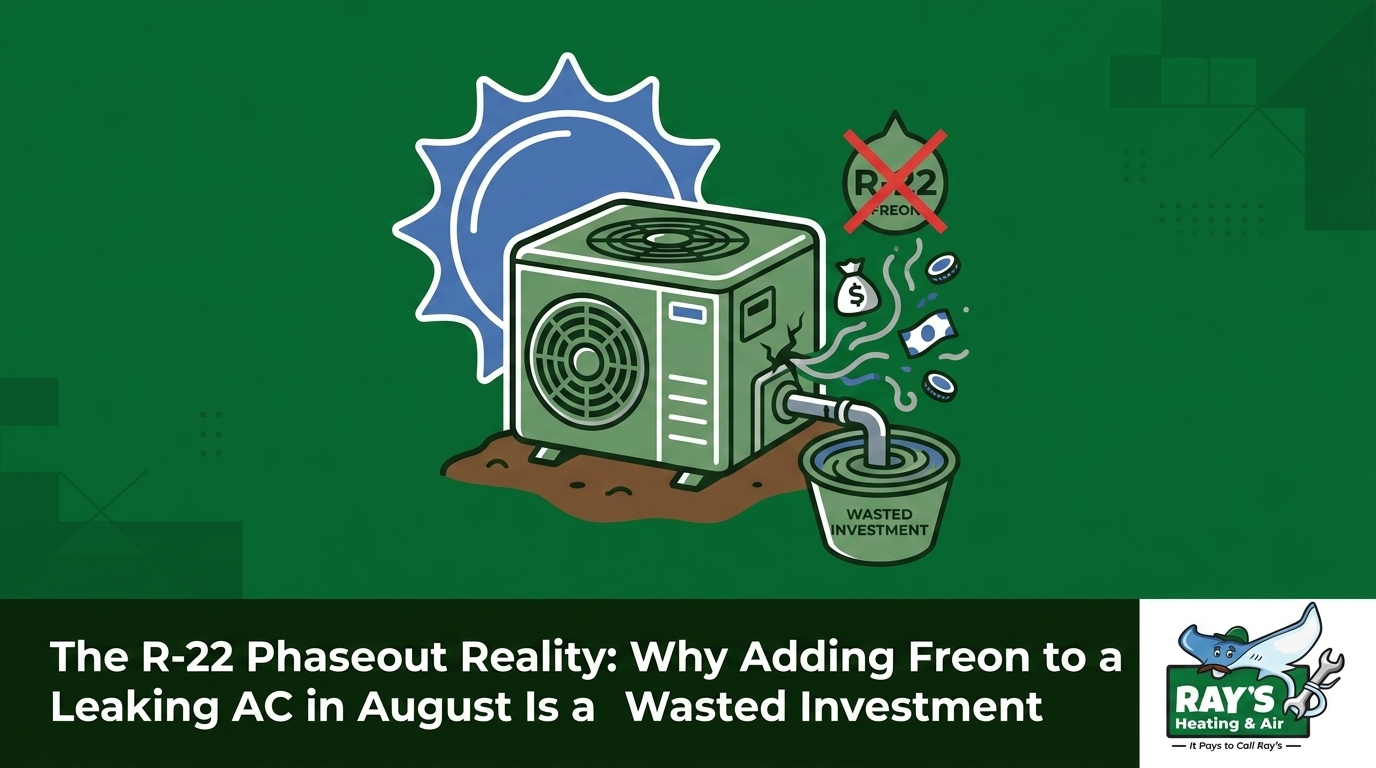
Topping off an older air conditioner with refrigerant doesn't cure a failing system—it merely masks a mechanical failure that is guaranteed to return. The R-22 phaseout reality: why adding Freon to a leaking AC in August is a wasted investment becomes painfully clear when your vents start blowing warm air during peak August late-summer humidity. At Ray's Heating & Air, we constantly see homeowners faced with a difficult decision: pay for a temporary chemical patch to limp through the final weeks of the season, or invest in a permanent mechanical solution.
Many homeowners operate under the misconception that air conditioners occasionally need their refrigerant "recharged" as part of normal operation. This myth leads to thousands of wasted dollars every summer. Modern cooling services provided by our team prioritize long-term reliability over these temporary band-aids. Instead of pouring funds into an obsolete system that will inevitably fail again, evaluating AC replacement services in Yardley is often the most financially sound path to restoring dependable indoor comfort.
The Core Issue: Refrigerant Leaks Don't Fix Themselves
The problem: Central air conditioning systems operate on a closed-loop refrigeration cycle. By design, they do not consume, burn, or use up refrigerant over time. If your system is low on Freon, you do not have a consumption issue—you have a physical hole in your equipment.
The cause: Over years of operation, the copper evaporator coils inside older units are subjected to moisture, volatile organic compounds, and continuous temperature fluctuations. This environment breeds formicary corrosion, creating microscopic pinhole leaks across the coil. Because these leaks are often buried deep within the delicate fins of the coil, our technicians find that standard AC repair is frequently mechanically impossible or highly cost-prohibitive for aging R-22 equipment.
The solution: A trustworthy technician will always provide an honest diagnosis, telling you exactly when a repair has become a waste of money rather than upselling a quick fix. We see this pattern often. For example, our team at Ray's Heating & Air recently helped a customer when their aging heating and air conditioning systems required a complete design revamp. After we provided a clear explanation of why patching the old equipment was no longer viable, they opted for a professional installation of new, energy-efficient systems that completely eliminated their ongoing repair cycle.
Adding refrigerant to a leaking system in Yardley PA without fixing the underlying hole ensures that the new chemical will simply leak out again. It is a temporary band-aid that masks the true, failing state of the equipment while draining your maintenance budget.
Understanding the EPA R-22 Phaseout and Its Impact on Homeowners
To understand why an August top-off is a poor investment, you have to look at the regulatory landscape surrounding older refrigerants. The chemicals used to cool homes have evolved significantly due to environmental regulations, leaving older systems stranded without affordable support.
1. The environmental mandate: R-22, commonly known by the brand name Freon, is a hydrochlorofluorocarbon (HCFC). Decades ago, scientists identified that HCFCs contribute heavily to the depletion of the Earth's ozone layer, prompting international agreements to phase them out of production entirely.
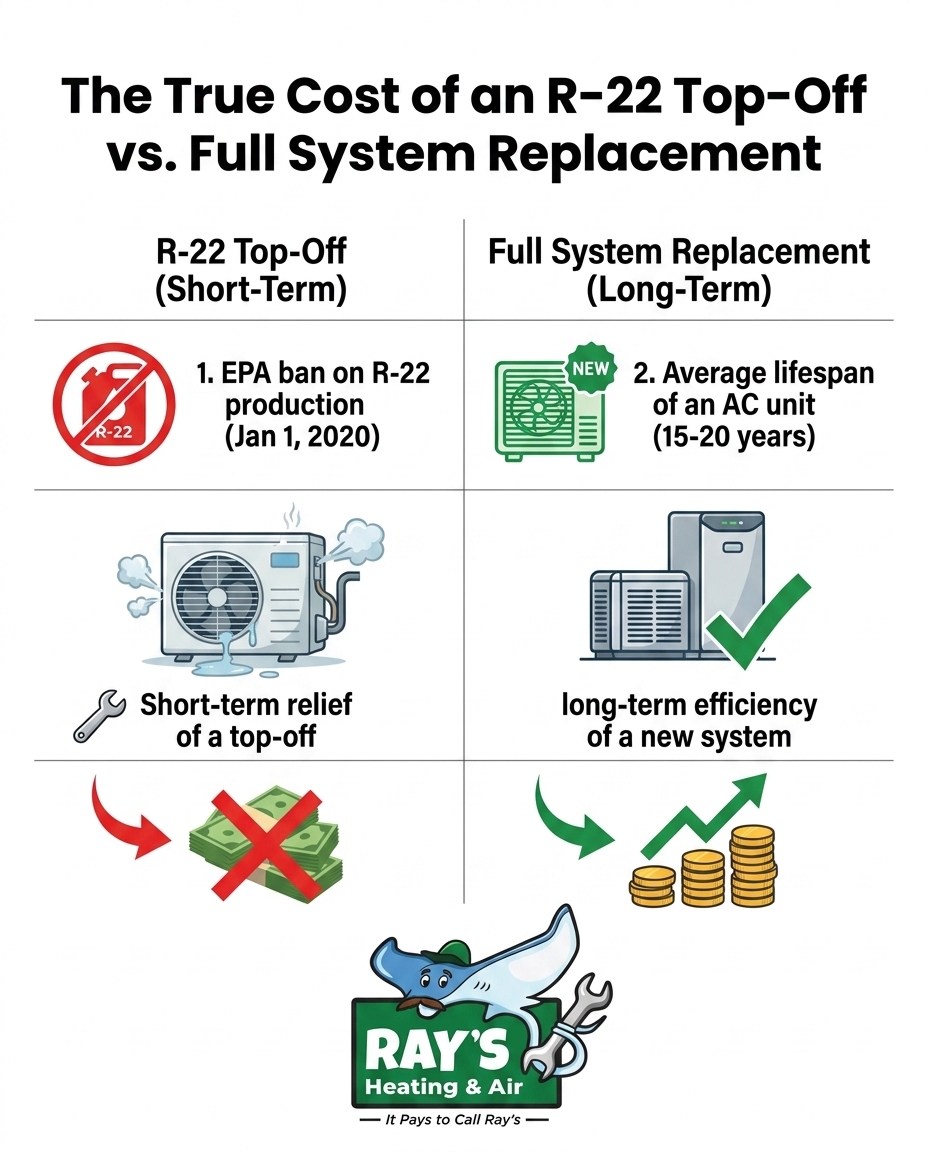
2. The 2020 production ban: On January 1, 2020, the Environmental Protection Agency (EPA) officially banned the production and import of R-22 in the United States. If your air conditioner was manufactured before 2010, it almost certainly relies on this obsolete refrigerant.
3. The dwindling reclaimed supply: Because no new R-22 is entering the market, the HVAC industry relies entirely on reclaimed and recycled supplies. As this finite inventory shrinks each year, the cost to acquire it climbs higher. In our experience, paying a premium for a rare chemical just to pump it into a leaking system during August late-summer humidity is a severe misallocation of household funds.
4. The danger of drop-in replacements: Some homeowners ask us about alternative, cheaper refrigerants. However, using "drop-in" chemicals in a system designed for R-22 can drastically reduce cooling capacity, alter operating pressures, and ultimately destroy the aging compressor. There is no safe, cheap chemical shortcut for a failing R-22 system.
Dehumidification: The Hidden Victim of Low Refrigerant
Temperature control is only half of what your air conditioner does. The other half—and arguably the more important function during a Yardley PA summer—is dehumidification. When a system loses refrigerant through a leak, its ability to extract moisture from your indoor air plummets long before it completely stops blowing cold air.
The physics of moisture removal: Your indoor evaporator coil must reach a very specific, cold temperature to cause the humidity in your air to condense into water droplets, which then drain away. When the system is undercharged due to an R-22 leak, the coil cannot maintain that precise temperature. The system may run continuously, racking up massive utility bills, but the air inside your home will feel thick, sticky, and uncomfortable.
The impact of regional weather: Yardley PA's oppressive late-summer humidity makes an undercharged system completely ineffective. As local experts, we know that when dew points rise late in the season, a leaking unit simply cannot keep up. You are left paying for continuous electricity usage while suffering through clammy indoor conditions.
The strain on the compressor: Operating with low refrigerant also starves the compressor of the cooling vapor it needs to prevent overheating. As the system runs endlessly trying to satisfy the thermostat in a highly humid environment, the compressor sustains irreversible thermal damage, accelerating the timeline toward a catastrophic total system failure.
Comparing Your Options: The Band-Aid Fix vs. Full System Replacement
When faced with a warm house and a leaking R-22 system, mapping out the long-term implications of your choices makes the decision much clearer. One path offers a few weeks of uncertain relief; the other provides guaranteed, efficient performance for years to come.
• Immediate Outcome — The August R-22 Top-Off: Temporary cooling until the refrigerant inevitably leaks out again. — Full System Replacement: Immediate restoration of reliable, high-capacity cooling and dehumidification.
• Financial Investment — The August R-22 Top-Off: Sunk costs into obsolete chemicals and labor with zero return on investment. — Full System Replacement: Investment in modern equipment that adds value to the home and reduces monthly utility bills.
• Ongoing Risk — The August R-22 Top-Off: High probability of compressor failure or a secondary leak before the season ends. — Full System Replacement: Comprehensive manufacturer warranty protection covering major components for up to a decade.
• Energy Efficiency — The August R-22 Top-Off: Continues to operate at the degraded efficiency of a 15+ year old failing unit. — Full System Replacement: Leverages modern, high-efficiency technology (R-410A or R-454B) to minimize electrical consumption.
The contrast is stark. For instance, our installation crew recently helped a local homeowner who faced a similar dilemma with an AC unit that had served them for decades. After a thorough assessment of the old unit's condition and a discussion about the long-term benefits of upgrading, they decided to move forward with a replacement. We installed a new, efficient unit the very same day, instantly ending their cycle of anxiety and repair bills in Yardley PA.
The True Cost of Waiting
Putting off a replacement might feel like saving money today, but the math rarely works out in the homeowner's favor. If you pay to patch a leak now, the system will sit idle all winter. Come next spring, our service technicians often find that the unit has leaked empty again, forcing the homeowner to pay for a replacement anyway. Furthermore, struggling, inefficient systems draw significantly more amperage to operate, quietly inflating your monthly utility bills while delivering subpar comfort.
Why the End of Summer Is the Critical Tipping Point for Upgrades
Late summer brings a unique set of challenges for aging HVAC equipment. After battling through June and July, older systems carry the cumulative stress and mechanical wear of the entire cooling season. This is precisely why we see so many catastrophic breakdowns happen in August.
• Cumulative mechanical fatigue: Motors, capacitors, and compressors that have been running constantly for months are highly susceptible to failure when subjected to the final, brutal heat waves of the season.
• Household routine disruptions: As families transition out of vacation mode and into structured back-to-school routines, a home without air conditioning becomes a major disruption. Sleep quality plummets, and daily schedules are thrown into chaos.
• Preparation for seasonal shifts: Upgrading now ensures your home is prepared for any unexpected late-season heat waves. Furthermore, modern HVAC installations often include advanced heat pump technology, giving you a massive head start on efficient winter heating before the first frost arrives.
At Ray's Heating & Air, we see the urgency of late-summer failures constantly. During a recent 100-degree heat wave, one of our customers needed to replace two failing heat pumps immediately. Because we provided clear product information and prompt service, the new systems were installed successfully despite the extreme weather, delivering honest and timely support when it mattered most. Securing reliable comfort across Bucks County before the season transitions is a proactive strategy that pays immediate dividends.
Making a Financially Sound Investment in Your Home's Comfort
Walking away from obsolete R-22 equipment is the smartest financial move you can make for your home's infrastructure. Every dollar spent trying to revive a 15-year-old leaking air conditioner is a dollar you will never get back. Redirecting that budget toward a modern installation stops the financial drain and immediately upgrades your daily living experience.
Leveraging incentives: Upgrading to a high-efficiency system often opens the door to financial benefits. Depending on the equipment you choose, you may qualify for generic energy rebates, federal tax credits for high-efficiency heat pumps, or local utility incentive programs. While we always advise verifying current programs with your utility provider or a tax professional, these incentives can significantly offset the initial investment of a new system.
Seamless transitions: Many homeowners dread the installation process, fearing days of disruption. The reality is that modern installations orchestrated by our experienced professionals are highly streamlined. Our technicians arrive with a clear plan, protect your property, and typically have the new system running by the end of the day.
Choosing the right partner: The longevity and efficiency of your new equipment depend entirely on the quality of the installation. Partnering with highly rated local experts ensures the system is sized correctly for your specific square footage and installed strictly to manufacturer specifications. Taking the time to research the best HVAC companies in Yardley guarantees that your investment is protected by skilled craftsmanship and the honest regional expertise we provide right here in Yardley PA.
Frequently Asked Questions About R-22 and AC Upgrades
Should I replace my R-22 air conditioner?
Yes, if your system requires major repairs or a refrigerant charge, our team strongly recommends replacement as the most logical step. Because R-22 is completely obsolete and banned from production, the cost to maintain these systems is unjustifiable. Furthermore, any air conditioner still utilizing R-22 is well past its expected lifespan and will continue to suffer from mechanical failures and poor energy efficiency.
Why is R-22 refrigerant so hard to find?
The EPA officially banned the production and import of R-22 on January 1, 2020, due to its harmful effects on the ozone layer. As a result, the HVAC industry must rely solely on reclaimed and recycled supplies to service older units. This finite, shrinking inventory makes the chemical increasingly rare and exceptionally expensive to procure for standard maintenance.
Can a Freon leak be fixed permanently?
While some accessible leaks on copper lines can be brazed and sealed, leaks inside older, corroded evaporator coils generally cannot be permanently repaired. The formicary corrosion that causes these pinhole leaks compromises the entire structure of the metal. Patching one hole usually means another will open shortly after, necessitating a full coil or system replacement.
Can you put modern refrigerant in an old R-22 system?
No, air conditioning systems are engineered to operate at the specific pressures and temperatures of their designated refrigerant. Attempting to put a modern chemical like R-410A into an older R-22 system will cause the compressor to fail catastrophically almost immediately. There are no safe, direct drop-in replacements that restore full factory capacity without risking the equipment.
How long does a typical central air conditioner last?
According to the Department of Energy, a well-maintained central air conditioning system typically lasts between 15 to 20 years. Once a unit crosses the 15-year mark, major components like the compressor and evaporator coil begin to degrade rapidly. If your system was installed before 2010, it has already exceeded its reliable operational lifespan.
Stop Wasting Money on Leaks: Secure Your Comfort Today
Navigating an AC breakdown during August late-summer humidity is stressful, but understanding the mechanical reality of your equipment makes the path forward clear. By recognizing that an R-22 top-off is merely a sunk cost, you can confidently choose to invest in a permanent, high-efficiency solution. Stop wasting your household funds on an ongoing leak that will only leave you stranded again next spring. Schedule a professional consultation with Ray's Heating & Air today to evaluate your replacement options, and secure reliable, lasting comfort for your home.
Recent Posts