


Battling Uneven Temperatures: The Split-Level Heating Dilemma
If you are constantly adjusting the thermostat because the lower den feels like an icebox while the upper bedrooms feel like a sauna, navigating a Heat Pump vs. Gas Furnace: Choosing the Right Heating Upgrade for a Yardley Split-Level is the most important decision you will make this season. At Ray's Heating & Air, we hear this exact complaint from Bucks County homeowners every fall. Older multi-level homes are notorious for severe airflow bottlenecks that make consistent indoor comfort feel impossible. You likely spend your evenings bundled in blankets on the ground floor, only to wake up sweating in the middle of the night on the top floor. This frustrating cycle is not a flaw in your thermostat; it is a direct result of how your home's architecture interacts with its heating equipment.
As the early fall pre-heating season arrives, this is the critical window to evaluate your current setup. Waiting until your furnace fails on a freezing January night forces you into an emergency replacement, often leading to rushed decisions that fail to solve the underlying temperature imbalances. Right now, you have the time to carefully assess the core problem: aging split-level homes simply do not move air efficiently across multiple half-levels.
The impending decision point between installing a modern heat pump and sticking with a traditional gas furnace will dictate your home's comfort for the next fifteen to twenty years. Upgrading your heating systems requires more than just swapping out a metal box in the basement. It requires a strategic approach to how air is distributed throughout your home's unique layout. By understanding the physics of your staggered floors, our team can help you choose a system that finally eliminates those stubborn hot and cold spots.
The Architectural Physics of Yardley's Staggered Floors
To understand why your home is so difficult to heat evenly, you have to look at the underlying structural physics. In our years of providing HVAC solutions, the technicians at Ray's Heating & Air have seen firsthand that in Yardley PA older split-level developments, the architecture itself fights against balanced temperatures. These homes were widely constructed between the 1960s and 1980s, featuring three or four staggered half-levels connected by short flights of open stairs. While this design creates a beautiful, open-concept feel, it creates an absolute nightmare for standard HVAC systems.
The Unforgiving Stack Effect
The primary culprit behind your uneven temperatures is a principle known as the stack effect. Basic physics dictates that warm air naturally rises while cold, dense air sinks. In a standard two-story home, doors and enclosed stairwells provide some separation. In a split-level home, the open staircases act as giant funnels. The heat generated on the lower levels immediately rushes upward to the highest point in the house—usually the master bedroom. Meanwhile, the cold air from the upper floors cascades down those same stairs, pooling in the lower den, basement, or converted garage.
Ductwork Limitations of the Past
Compounding the stack effect is the reality of 1960s-era ductwork. When these homes were originally built, builders often prioritized cost-effective duct routing over optimal airflow design.
• Undersized returns: Many older split-levels have only one centrally located return vent, making it impossible to pull stagnant, cold air out of isolated lower rooms.
• Long duct runs: The ductwork stretching to the furthest upper bedrooms often loses pressure and heat before the air ever reaches the register.
• Static pressure issues: Original ducts were sized for older, lower-efficiency blowers that simply cannot push air effectively through modern, high-efficiency filters.
Because of these architectural quirks, finding the best HVAC systems for older Bucks County homes means looking beyond the equipment's efficiency rating. You have to evaluate how the system delivers its air. If a system cannot overcome the stack effect and push through the limitations of mid-century ductwork, it will never keep your staggered floors comfortable.
Gas Furnaces: High-Capacity Heat vs. Airflow Bottlenecks
For decades, the traditional gas furnace has been the default heating source for northeastern homes. There is no denying that gas furnaces provide incredibly powerful, high-capacity heat. When the burners ignite, the system generates air temperatures that can exceed 120 degrees Fahrenheit at the supply register. This blast of intense heat warms up the immediate surrounding area very quickly.
The Problem with Intermittent Heat Blasts
However, our technicians frequently see that exact strength become a major liability in Yardley PA older split-level developments. Traditional single-stage gas furnaces operate on a blast-and-stop cycle. When the thermostat detects a drop in temperature, the furnace kicks on at full blast. It pumps out high-temperature air until the thermostat—which is usually located on the middle floor—reaches the set temperature. Then, the system shuts off completely.
This intermittent operation exacerbates temperature stratification across staggered floors. The blast of hot air rapidly rises to the top floor, overheating the bedrooms. Because the furnace satisfies the middle-floor thermostat so quickly, the blower shuts down before it has a chance to push adequate heat into the furthest corners of the lower den. Once the blower stops, the air stagnates, the stack effect takes over again, and the lower levels remain freezing.
Evaluating Furnace Replacements
If you are exploring furnace replacement services, it is vital to consider how a new unit will interact with your existing ductwork.
• Short cycling risks: An oversized furnace will short-cycle, turning on and off rapidly, which increases wear and tear while failing to mix the air throughout the house.
• Fuel source limitations: Older homes relying on oil or aging gas lines may face expensive infrastructure upgrades to accommodate high-efficiency condensing gas furnaces.
• Airflow volume: Furnaces rely on sheer heat intensity rather than high airflow volume, meaning isolated rooms with poor duct connections will continue to struggle.
While a modern, variable-speed gas furnace can certainly improve comfort compared to a 30-year-old unit, the fundamental nature of combustion heating means it is constantly fighting an uphill battle against the natural airflow bottlenecks of a split-level design.
Heat Pumps: Using Continuous Airflow to Balance Temperatures
Modern heat pumps offer a fundamentally different approach to climate control, one that directly counters the airflow challenges of staggered floors. Instead of burning fossil fuels to create sudden blasts of intense heat, heat pumps absorb ambient heat from the outside air, compress it, and transfer it indoors. This process relies on a continuous, lower-temperature airflow rather than intermittent, high-temperature spikes.
The Power of Constant Circulation
The secret to a heat pump's success in a split-level home lies in its variable-speed blower technology and continuous air circulation. Because a heat pump delivers air at a slightly lower temperature (usually between 90 and 100 degrees Fahrenheit), it needs to run for longer periods to satisfy the thermostat. This massive advantage is something we highlight for homeowners struggling with comfort.
By running continuously at lower speeds, the heat pump acts as a giant air mixer. It constantly pulls cold air from the lower levels through the return ducts and pushes conditioned air into the upper levels. This relentless circulation breaks up the stagnant air pockets, prevents the stack effect from taking hold, and equalizes the temperature across all three or four half-levels. The result is an elimination of the extreme hot and cold spots that plague Yardley PA older split-level developments.
Year-Round Split-Level Comfort
Beyond heating, heat pumps provide the distinct advantage of dual functionality. They are complete year-round systems that handle both heating and cooling. During the summer, the system simply reverses its operation, pulling heat and humidity out of your stifling upper bedrooms and transferring it outside.
We see the impact of this dual functionality firsthand in the local community. Just recently, as the early fall transition began, a local homeowner reached out to Ray's Heating & Air to replace two aging heat pumps before the winter freeze. Our team provided clear product information, performed the installation, and got the new systems running successfully. By upgrading to modern, variable-speed units, that homeowner secured balanced temperatures across their split-level home for the upcoming winter chill, while also prepping for next summer's heat. If you are considering a heat pump installation, you are investing in a comprehensive, year-round solution to your home's structural airflow challenges.
Cold Weather Performance: Beating the Pennsylvania Winter
One of the most persistent myths our team at Ray's Heating & Air encounters is that heat pumps cannot handle the freezing temperatures of a northeastern winter. While this may have been true for units manufactured in the 1990s, today's technology has completely rewritten the rules of cold-weather heating.
Modern Cold-Climate Technology
During the early fall pre-heating season, homeowners often worry about how a heat pump will perform when the January temperatures plummet into the teens. Modern cold-climate heat pumps are engineered specifically for these extreme seasonal shifts. They utilize advanced inverter-driven compressors and specialized refrigerants that can extract ambient heat from the outside air even when the thermometer drops to negative 15 degrees Fahrenheit.
These systems do not rely on energy-draining electric resistance strips as their primary backup. Instead, the compressor simply speeds up to draw more heat from the frigid air, maintaining consistent indoor comfort without the massive energy spikes associated with older technology. For a split-level home, this means you maintain that crucial, continuous airflow even during the coldest weeks of the Pennsylvania winter.
The Dual-Fuel Configuration Strategy
For homeowners who want the ultimate peace of mind during extreme cold snaps, a dual-fuel system (also known as a hybrid system) offers the best of both worlds. This configuration pairs a high-efficiency electric heat pump with a backup gas furnace.
1. Mild winter days: When temperatures are in the 30s, 40s, and 50s, the heat pump handles all the heating, utilizing its continuous airflow to keep the staggered floors perfectly balanced.
2. Extreme cold snaps: If the temperature drops below a specific, pre-set balance point (typically around 25 degrees), the system automatically switches over to the gas furnace.
3. Seamless transition: The furnace provides the high-capacity heat needed to conquer the bitter cold, and the system switches back to the heat pump as soon as the weather moderates.
This hybrid approach ensures you never lose heating capacity while still maximizing the air-mixing benefits of a heat pump for 80 percent of the winter season.
Retrofitting Older Ductwork: A Crucial Installation Step
Simply purchasing top-of-the-line equipment will not solve your split-level temperature issues if your ductwork cannot handle the new system. Swapping a gas furnace for a heat pump requires careful attention to airflow volume. Because heat pumps deliver lower-temperature air, they must push a higher volume of air (measured in cubic feet per minute, or CFM) through the ducts to deliver the same amount of total heat.
Adapting 1970s Infrastructure
In Yardley PA older split-level developments, the existing ductwork is rarely sized to handle this increased airflow volume right out of the box. If a contractor simply attaches a new heat pump to undersized, 40-year-old ducts, the system will choke. You will experience loud whistling noises at the vents, the blower motor will burn out prematurely from high static pressure, and your lower den will remain just as cold as it was before.
Properly modifying split-level ductwork is a specialized process. It often involves:
• Expanding the return plenum: Increasing the size of the main return drop at the equipment to allow the blower to breathe freely.
• Adding low-level returns: Installing new return grilles in the lowest, coldest rooms to pull stagnant air back to the system for heating.
• Sealing duct leaks: Aerosealing or manually mastic-sealing the joints in the basement or crawlspace to ensure the conditioned air actually reaches the upper bedrooms.
The Value of Local Expertise
Working with a local team that possesses deep expertise in the unique structural challenges of local 1960s-1980s housing stock is vital. You need technicians who know exactly how to retrofit these specific architectural layouts.
We frequently handle these complex retrofits at Ray's Heating & Air. One local customer reached out early this fall to replace a heating system that had been running for 30 years. After a thorough assessment of the old unit and the home's aging infrastructure, our team discussed the necessary modifications, provided a clear assessment, and installed the new system quickly. A successful upgrade requires this level of professional system design and revamp to ensure the equipment and the ductwork operate as a unified, highly efficient system. When you need reliable HVAC services in Yardley, look for a team that prioritizes the ductwork just as much as the unit itself.
Side-by-Side Comparison: Heat Pump vs. Gas Furnace
As you weigh your options during the early fall pre-heating season, having a clear, scannable framework can help clarify your decision. Both systems have distinct operational differences that directly impact how they perform in a split-level environment.
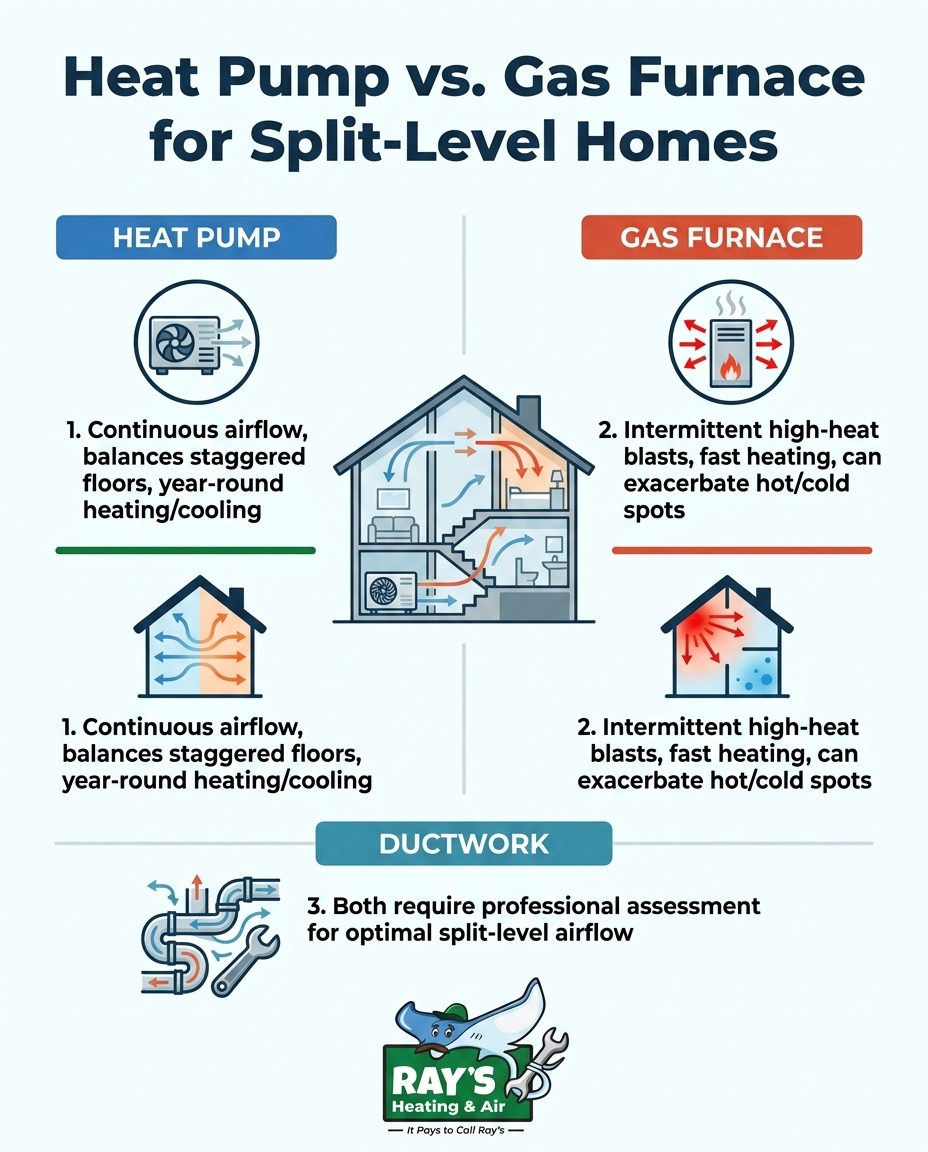
• Airflow Style — Modern Heat Pump: Continuous, lower-speed circulation that mixes air across staggered floors. — Traditional Gas Furnace: Intermittent, high-speed blasts that can worsen hot/cold spots.
• Temperature Balance — Modern Heat Pump: Excellent. Constant runtime prevents the stack effect from separating hot and cold air. — Traditional Gas Furnace: Poor to Fair. Short cycles leave isolated lower dens freezing.
• Energy Efficiency — Modern Heat Pump: Extremely high. Transfers existing heat rather than burning fuel to create it. — Traditional Gas Furnace: High (in condensing models), but limited by combustion fuel costs.
• Year-Round Utility — Modern Heat Pump: Provides both high-efficiency heating in winter and cooling in summer. — Traditional Gas Furnace: Provides heating only. Requires a separate central AC unit for summer.
• Ductwork Needs — Modern Heat Pump: Requires careful assessment to handle higher airflow volumes (CFM). — Traditional Gas Furnace: Generally compatible with older, smaller ductwork designs.
• Financial Incentives — Modern Heat Pump: Generic federal tax credits may apply to qualifying high-efficiency installations. — Traditional Gas Furnace: Fewer broad incentives; heavily dependent on local utility programs.
Remember to consult a tax professional to verify how generic federal tax credits or local utility incentives apply to your specific financial situation before making a final purchase decision.
Frequently Asked Questions About Split-Level Heating
Is a heat pump or furnace better for a split-level home?
Heat pumps often perform better due to continuous airflow mixing the air across the staggered floors. At Ray's Heating & Air, we frequently recommend them because while a furnace provides powerful blasts of heat, its short running cycles usually fail to push warm air into the lowest levels of the home. The constant circulation of a variable-speed heat pump prevents the warm air from rising entirely to the upper bedrooms, creating a much more balanced temperature profile throughout the house.
How do you fix uneven heating in a split-level house?
Address ductwork bottlenecks and consider systems that provide constant air circulation. You must conquer the natural stack effect, which pulls warm air up and forces cold air down. Adding return vents to the lowest levels, sealing leaky supply ducts, and upgrading to a variable-speed blower motor will force the air to mix properly, eliminating isolated cold zones in Yardley PA older split-level developments.
Can a heat pump heat a multi-level house effectively?
Yes, especially when ductwork is properly retrofitted to handle the required airflow volume. A heat pump excels in multi-level homes because its longer, slower heating cycles continuously stir the indoor air. As long as the ductwork is sized correctly to allow the blower to move the necessary cubic feet per minute (CFM), a heat pump will easily reach the furthest corners of a multi-story layout.
At what temperature does a heat pump become inefficient in Pennsylvania?
Modern cold-climate heat pumps remain efficient well below freezing, though dual-fuel options exist for extreme lows. Advanced inverter technology allows today's units to extract heat from the outside air even when temperatures drop to negative 15 degrees Fahrenheit. If you are concerned about extreme cold snaps, pairing a heat pump with a backup gas furnace ensures you have uninterrupted, high-capacity heat on the absolute coldest days of the year.
Do I need to replace my ductwork to switch to a heat pump?
Not necessarily replace, but older ductwork often requires professional modification to handle different air volumes. Because heat pumps operate with slightly lower air temperatures, they must push a higher volume of air through the vents to heat the home. An expert contractor will evaluate your static pressure and may widen your return drop or add supplementary vents to ensure the new system breathes properly without whistling or straining.
Secure Your Comfort Before Winter Arrives
Conquering the notorious airflow challenges of a split-level home requires more than just buying a new piece of equipment; it requires the right system paired with proper ductwork retrofitting. As the early fall pre-heating season progresses, you have a valuable opportunity to address those freezing lower dens and stifling upper bedrooms before the harsh weather sets in. Whether you lean toward the continuous, air-mixing power of a modern heat pump or the high-capacity strength of a gas furnace, our experts can clarify your best path forward. Schedule a comprehensive evaluation with Ray's Heating & Air today, and ensure that your Heat Pump vs. Gas Furnace: Choosing the Right Heating Upgrade for a Yardley Split-Level results in total, balanced comfort for your family all winter long.
Recent Posts


