The Smart Thermostat Myth for Radiant Heating Systems
Turning your thermostat down 10 to 15 degrees while you are at work doesn't automatically save money—especially if you rely on a boiler to keep your home comfortable. When evaluating Programmable vs. Smart Thermostats: Are Wi-Fi Upgrades Worth It for Radiant Heat?, the common advice you find on tech blogs often falls completely flat. Most generic energy-saving tips assume your home uses a forced-air furnace, which reacts to temperature changes in a fundamentally different way than a water-based radiator or baseboard system.
Before you commit to a new device during your October pre-winter heating startup, our team at Ray's Heating & Air providing local Heating Services and high-efficiency boiler installation across Yardley and the surrounding areas wants to set the record straight.
The primary disconnect lies in a concept called thermal mass. Tech enthusiasts love smart thermostats because their aggressive learning algorithms automatically drop the temperature when you leave the house and spike it right before you return. While this works beautifully for blowing hot air through vents, it creates chaos for a boiler. Boilers heat water, and water takes a significant amount of time and energy to reach its target temperature. When a smart thermostat allows a house with radiant heat to cool down too much, the boiler has to work overtime to recover that lost heat, erasing any potential energy savings.
Because of this, the most effective strategy for radiant heating is often to "set it and forget it." Finding a comfortable baseline temperature and leaving it there prevents your system from constantly playing catch-up. This reality brings up an important decision point for homeowners: if aggressive scheduling doesn't work for your system, is there still a valid reason to ditch your standard programmable unit for a modern Wi-Fi upgrade? Finding the true value requires looking past the standard marketing claims and understanding how these devices actually interact with your home's unique heating infrastructure.
Understanding Thermal Mass and Boiler Lag Times
To understand why standard setback schedules fail, you have to look at the mechanical differences between how different systems distribute warmth. Boiler-based radiant heating systems rely on heating a liquid—usually water—and circulating it through heavy cast-iron radiators, baseboards, or in-floor tubing. This process involves a tremendous amount of thermal mass. Water and metal retain heat exceptionally well, which provides a highly comfortable, even, and consistent warmth throughout the house.
However, that same thermal mass means the system cannot turn on a dime. This delay is known as boiler lag time. If your thermostat is set to 68 degrees and you drop it to 58 degrees while you are at work, the heavy cast iron and the water inside it will take hours to cool down. More importantly, when the thermostat signals the boiler to warm the house back up to 68 degrees at 5:00 PM, the system may take several hours to recover from that deep temperature drop. The boiler has to fire at maximum capacity for an extended period just to reheat the water, the metal radiators, and eventually the air in the room.
With steady Pennsylvania winter temperatures, this constant drastic fluctuation forces your equipment to overwork. Forcing a boiler to recover from a 10-degree setback during freezing weather causes it to burn more fuel than it would have used simply maintaining a steady 68 degrees all day. In our years of servicing boilers throughout Yardley, PA, our technicians at Ray's Heating & Air consistently see that steady operation drastically reduces mechanical wear and tear. A boiler that fires in short, gentle cycles to maintain a temperature will always outlast one that is constantly pushed to its limits trying to recover from deep setbacks.
Forced Air vs. Radiant Heat Response
The difference in response time dictates how you should control your system:
• Forced air systems: Provide immediate ambient heat. When a furnace kicks on, 120-degree air immediately blows into the room, raising the air temperature in minutes. These systems recover quickly from aggressive thermostat setbacks.
• Radiant heating systems: Warm objects and mass rather than just the air. They require a slow, steady burn to maintain comfort. The heat radiates outward gently, meaning sudden temperature adjustments are physically impossible.
Programmable vs. Smart Thermostats for Boilers: A Direct Comparison
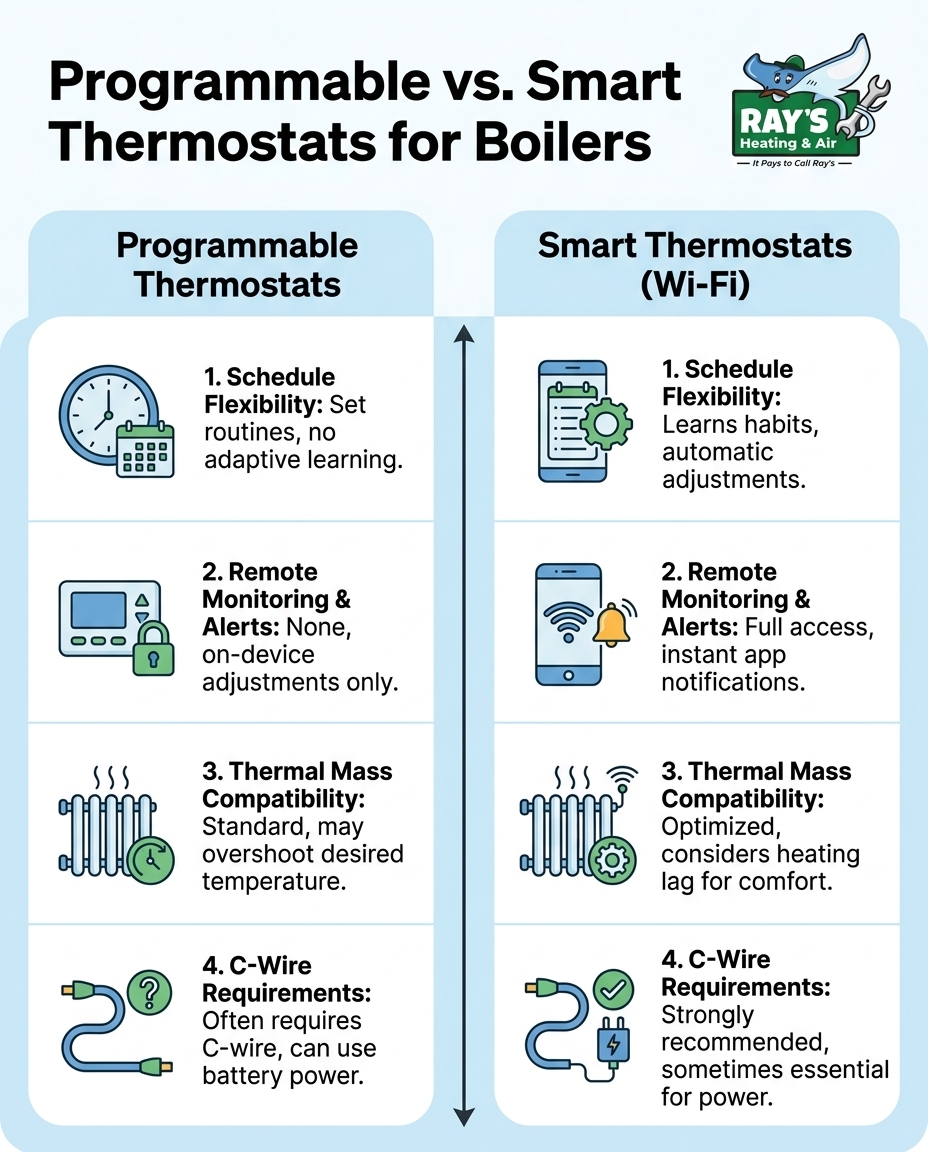
When deciding between a standard programmable thermostat and a Wi-Fi-enabled smart thermostat for boiler-based radiant heating systems, you have to evaluate them based on how they handle slow-response heating. Here is a direct look at how the two technologies stack up against each other.
• Schedule Flexibility — Standard Programmable Thermostat: Basic daily or 5-2 day schedules. You manually set the times and temperatures. — Smart (Wi-Fi) Thermostat: Advanced learning algorithms that adapt to your habits, though these features often need to be disabled for boilers.
• Remote Monitoring — Standard Programmable Thermostat: Local control only. You must physically walk up to the unit to check the temperature or make changes. — Smart (Wi-Fi) Thermostat: Full Wi-Fi app access. You can monitor home temperatures, adjust settings, and receive alerts from anywhere in the world.
• Thermal Mass Compatibility — Standard Programmable Thermostat: Excellent for "Permanent Hold" settings, making it very easy to maintain a steady, efficient baseline temperature. — Smart (Wi-Fi) Thermostat: Requires specific configuration (like Nest's "True Radiant" feature) to prevent the system from overshooting target temperatures.
• Energy Saving Strategy — Standard Programmable Thermostat: Relies entirely on user input. Savings come from finding the lowest comfortable baseline and leaving it there. — Smart (Wi-Fi) Thermostat: Marketed to save energy via away-modes, but for boilers, true savings come from tracking runtime and optimizing maintenance.
The comparison reveals a crucial truth: if your only goal is to set a schedule and walk away, a basic programmable thermostat does the job perfectly. It holds a steady temperature, which is exactly what your boiler wants. The learning algorithms that make smart thermostats famous—like sensing when you leave the room and dropping the temperature—are actually detrimental to radiant heat and usually need to be turned off.
However, modern smart thermostats have adapted to this limitation. High-end Wi-Fi models now include specialized settings designed specifically for radiant heat. Features like "True Radiant" learn exactly how long your specific boiler takes to heat your home. If you want the house at 70 degrees by 6:00 AM, the thermostat learns that it needs to turn the boiler on at 4:30 AM to achieve that, rather than waiting until 6:00 AM to start the process. This prevents the system from overshooting the target temperature and wasting fuel.
The Real Value of Wi-Fi Upgrades: Remote Monitoring and Alerts
If aggressive temperature setbacks don't work for radiant heat, you might wonder why anyone with a boiler would upgrade to a smart thermostat. The answer is simple: the true value of a Wi-Fi upgrade isn't in the scheduling—it is in the system monitoring. When you reframe the upgrade around visibility and protection, a smart thermostat becomes an incredibly powerful tool for your home.
During our October pre-winter heating startup visits, we constantly remind our customers that establishing remote access to your heating system provides peace of mind that a standard programmable unit simply cannot match. Based on the emergency calls we field every winter, here is where Wi-Fi thermostats truly earn their keep for boiler owners:
1. Real-Time Freeze Protection Alerts: If your boiler fails while you are at work or away on vacation, a standard thermostat will blindly continue asking for heat while the house freezes. A smart thermostat will detect that the ambient temperature is dropping rapidly and send an emergency alert directly to your phone. This early warning can save you from catastrophic burst pipes and severe water damage.
2. Tracking Boiler Runtime: Smart thermostats provide detailed energy reports showing exactly how many hours your boiler runs each day. If you notice the system is suddenly running for 14 hours a day to maintain the same temperature it used to hold with 8 hours of runtime, you immediately know the system is losing efficiency.
3. Proactive Maintenance Reminders: Modern thermostats track your system's usage and can alert you when it is time for routine service. Staying on top of these reminders makes scheduling boiler tune-up services much easier, ensuring your equipment is cleaned and calibrated before peak winter weather arrives.
4. Travel Monitoring: If you travel frequently during the winter, being able to open an app and verify that your house is sitting at a safe, comfortable 65 degrees provides immense relief. You never have to wonder if the heat is still on.
By shifting the focus from micro-managing temperatures to macro-managing system health, a smart thermostat transforms from a simple switch on the wall into a comprehensive diagnostic tool for your boiler.
Integrating Modern Thermostats with Historic Home Infrastructure
Upgrading to a smart thermostat isn't always as simple as swapping a faceplate, especially in areas with older architecture. Bucks and Montgomery Counties feature a high concentration of historic homes utilizing aging boiler-based radiant heating systems. Marrying modern Wi-Fi technology with decades-old boiler infrastructure requires careful planning and a solid understanding of electrical requirements.
In our experience upgrading HVAC controls in Yardley's older neighborhoods, the most common hurdle homeowners face is the C-wire (common wire) requirement. Smart thermostats feature bright, full-color displays and maintain a constant Wi-Fi connection. They require a steady stream of 24-volt power to operate. Older thermostats ran on batteries or pulled minimal power through the existing two heating wires. Because older boilers only needed a simple switch to turn on and off, the original installers rarely ran a dedicated C-wire to the thermostat location.
If you try to install a smart thermostat without a proper C-wire, the device may attempt to steal power from the heating circuit. This "power stealing" can cause the boiler's relays to chatter, leading to rapid short-cycling. Short-cycling forces the boiler to turn on and off every few minutes, which severely damages the internal components and wastes a massive amount of fuel.
Additionally, some historic properties use line-voltage thermostats (which handle full 120V or 240V electricity directly) rather than the low-voltage (24V) systems required by modern smart devices. Working with a team that has specialized knowledge in boiler systems and historic home HVAC—like Ray's Heating & Air—prevents homeowners from making well-intentioned but incompatible smart home upgrades. A professional assessment ensures that your wiring can safely support a new device, whether that means pulling new thermostat wire, installing an add-a-wire adapter, or fitting an isolation relay at the boiler itself to protect the best HVAC systems for historic homes.
When to Keep Your Standard Programmable Thermostat
While remote monitoring is highly beneficial, a Wi-Fi upgrade isn't strictly necessary for every household. At Ray's Heating & Air, our goal is to provide honest, objective advice, and we often tell our local customers there are several situations where keeping your current thermostat is the smartest move. If your current unit is accurately reading the room temperature and communicating properly with your equipment, you may not need to change a thing.
Consider keeping your standard programmable unit if:
• You prefer a strict "set it and forget it" approach: If you keep your thermostat locked at 68 degrees all winter and rarely feel the need to adjust it, a basic programmable unit handles this task flawlessly. A perfectly functioning unit maintaining a steady temperature is highly efficient for boiler-based radiant heating systems.
• Someone is always home: If you work from home, are retired, or have a multi-generational household where the house is rarely empty, aggressive scheduling or remote access offers very little practical benefit.
• Your wiring makes an upgrade cost-prohibitive: If a professional assessment reveals that your historic home lacks a C-wire and running a new wire would require opening up plaster walls or navigating complex chases, the cost of the installation may outweigh the benefits of the smart thermostat.
• You don't want another app on your phone: If the idea of troubleshooting Wi-Fi connectivity or dealing with software updates on your thermostat sounds frustrating, sticking with a reliable, push-button programmable model ensures your heat turns on exactly when you ask it to.
Before committing to a switch, evaluate how your current system performs. If the house feels evenly heated and you aren't worried about monitoring the home while traveling, a standard unit paired with proactive boiler repair services when needed is a perfectly valid long-term strategy.
Frequently Asked Questions About Thermostats and Radiant Heat
Do smart thermostats work with radiant heat?
Yes, smart thermostats work with radiant heat, but they must be configured correctly. Because radiant systems have high thermal mass and respond slowly, the aggressive "away" schedules and learning algorithms used for forced-air systems must usually be disabled. Instead, the thermostat should be set to recognize the boiler's lag time so it doesn't overshoot the target temperature.
Does lowering the thermostat at night save money with radiant heat?
Lowering the thermostat significantly at night rarely saves money with radiant heat. Boiler-based radiant heating systems take hours to recover from deep temperature drops. The energy the boiler expends running at maximum capacity the next morning to reheat the water and the cast iron often exceeds the energy saved during the night. A steady temperature is generally more efficient.
Can you use a Nest or Ecobee thermostat with a boiler?
Yes, you can use popular smart thermostats like Nest or Ecobee with a boiler, provided your home has the correct wiring. These devices typically require a C-wire for constant power. Additionally, you must enable specific settings within the app—such as Nest's "True Radiant" feature—to ensure the thermostat understands it is controlling a slow-response heating system rather than a fast-acting furnace.
Why is my radiant heat taking so long to warm up?
Radiant heat takes a long time to warm up because it relies on heating thermal mass. The boiler must heat the water, which then travels through the pipes to heat the heavy metal radiators or baseboards, which eventually radiate heat into the room. This process naturally takes much longer than a furnace blowing hot air, which is why "set it and forget it" is the recommended operating strategy.
What is the most efficient temperature setting for a boiler in winter?
The most efficient temperature setting for a boiler is the lowest temperature at which your family feels consistently comfortable, left at a steady hold. For many homes, this is between 68 and 70 degrees. Maintaining this baseline prevents the boiler from constantly cycling on and off or overworking to recover from deep temperature setbacks.
Making the Right Thermostat Choice for Your Radiant Heat System
The debate between programmable and smart thermostats for boiler systems comes down to understanding what you actually need the device to do. If you are looking for massive energy savings through aggressive temperature setbacks, a smart thermostat will likely disappoint you, as radiant heat's thermal mass requires a steady, consistent approach. However, if you want the peace of mind that comes with real-time freeze alerts, remote monitoring while traveling, and detailed system health reports, a Wi-Fi upgrade is an incredibly worthwhile investment.
Because integrating modern technology with older boiler infrastructure can be complex, it is always best to have your wiring evaluated before making a purchase. If you live in Bucks and Montgomery Counties and want to ensure your heating system is optimized for the winter ahead, reach out to our team at Ray's Heating & Air to have one of our local Yardley experts assess your system and recommend the perfect control solution for your home.
Recent Posts