


The Hidden Threat Lurking in Your Boiler Over the Summer
Your radiators might be completely silent right now, but the real reason we clean your boiler pipes before the first fall freeze has been quietly brewing since you turned the system off in May. A common misconception among homeowners is that a heating system simply goes to sleep during the warmer months and wakes up perfectly fine in the fall. The truth is much more complicated. While your boiler sits idle, the water trapped inside the miles of piping stops moving. This stagnation creates the perfect environment for a hidden threat to develop: hard water minerals and heavy sediment begin settling out of suspension, collecting at the bottom of your pipes and hardening into stubborn scale.
This creates a critical decision point for you as a homeowner. You can either schedule a proactive pipe flush during the September pre-heating season, or you can wait and risk dealing with banging pipes, uneven heat, and potential system lockouts when the first freezing night forces your boiler into high gear. The transition from humid Pennsylvania summers—where water sits stagnant in your pipes for months—to sudden, bitter late-fall freezes means your heating equipment must go from zero to maximum capacity almost overnight. If those pipes are choked with hardened summer sediment, the system simply cannot handle that heavy load.
The proactive approach: Getting ahead of this hidden threat requires professional intervention before the cold weather actually arrives. By addressing the stagnation early, you ensure your equipment operates safely and efficiently. For comprehensive heating services, a thorough evaluation of your pipe network is the first step toward a warm, reliable winter.
What Happens to Water in Your Heating System During Dormant Months?
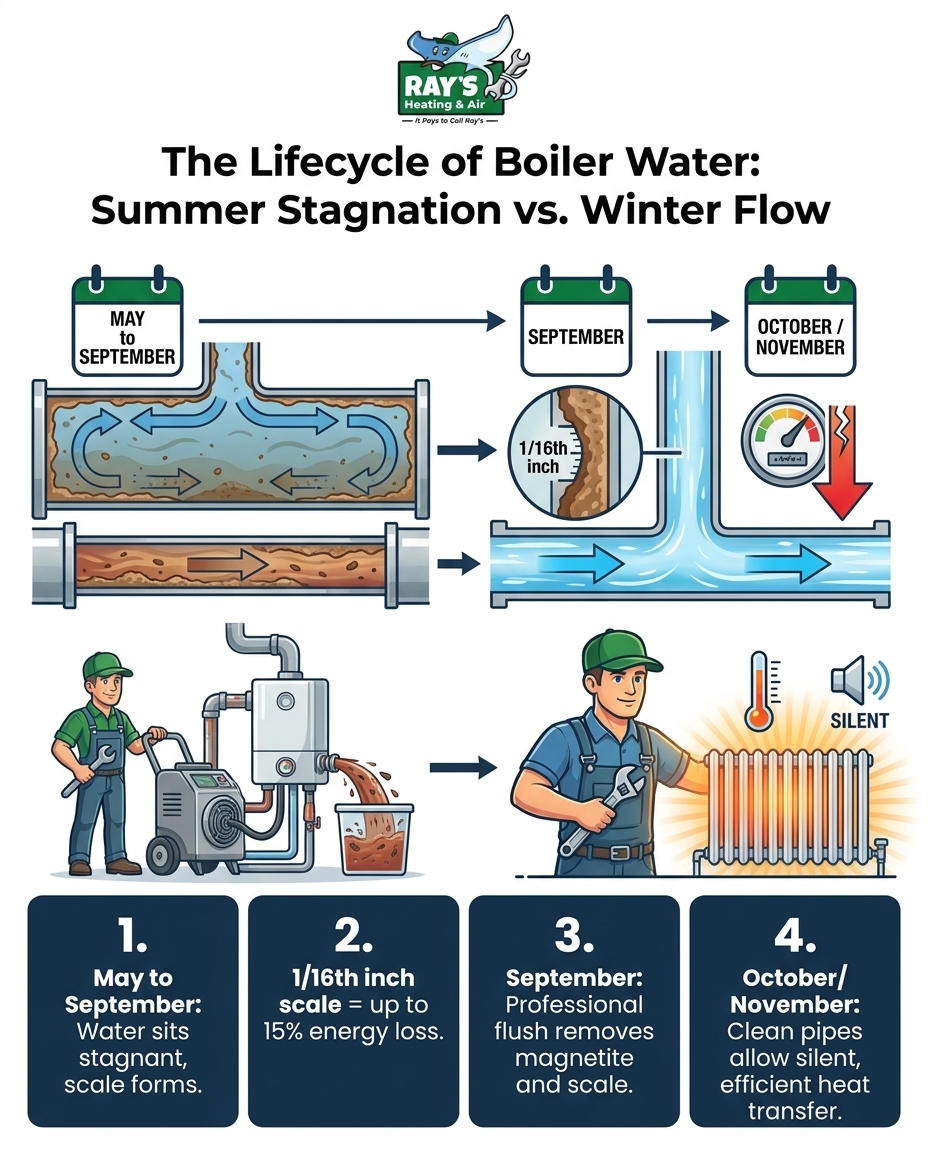
To understand why fall preparation is so important, you have to look at the chemistry of the water sitting inside your house. In many Yardley PA homes with radiator or baseboard boiler systems, the water inside the closed-loop network does not drain out when summer arrives. Instead, it sits completely motionless for four to five months. This dormant period acts as a massive incubator for scale and sludge.
The science of hard water scaling: Tap water naturally contains dissolved minerals, primarily calcium and magnesium. When water is heated and circulated during the winter, these minerals generally stay suspended. However, when the water stops moving in May, gravity takes over. The dissolved minerals slowly separate from the water and drift downward, settling on the interior walls of your pipes and the bottom of your boiler tank. Over the course of the summer, these soft deposits harden into a rock-like scale.
The impact of this scale is severe. According to Department of Energy guidelines, even a tiny 1/16th of an inch of scale buildup can increase a boiler's energy consumption by up to 15%. This means the system has to burn significantly more fuel just to push heat through that insulating layer of rock. A pipe that was relatively clear in May can become highly restricted by September, forcing the circulator pump to work twice as hard to move water through the house.
The professional solution: Reversing this chemical process requires more than just turning a valve. It requires specialized boiler maintenance to break down those hardened minerals and flush them entirely out of the closed-loop system before the heavy heating load begins.
The Formation of Boiler Sludge
Beyond basic calcium scale, stagnant summer water also creates a much darker problem known as boiler sludge, or magnetite. Magnetite is a heavy, black, mud-like substance that forms from the natural chemical reaction between the water and the interior metal components of your heating system.
• Chemical reaction: As the water sits still, trace amounts of oxygen react with the iron and steel in the pipes, creating microscopic rust particles.
• Pooling and settling: Because there is no circulation to keep these particles moving, the heavy black sludge sinks. It pools at the lowest points of the system—usually inside the boiler heat exchanger itself, or at the bottom of ground-floor radiators.
• Hardening: Over the summer, this wet mud compresses and hardens, creating a dense blockage that water cannot easily pass through once the system is turned back on.
Boiler Kettling: Why Your Pipes Bang and Knock on the First Freezing Night
When you skip a pre-season cleaning, the first truly cold night of the year often brings a terrifying sound from the basement. You might hear loud banging, violent knocking, or a deep rumbling noise that shakes the floorboards. This alarming condition is known as "boiler kettling," and it is the direct result of the sediment and sludge that built up over the summer.
The mechanics of kettling: Kettling occurs when heavy sediment buildup restricts the normal flow of water inside the boiler's heat exchanger. Because the water cannot move fast enough through the blocked passages, it gets trapped directly over the burner flames. This trapped water rapidly boils and turns into steam. Expanding steam bubbles then travel up into the cooler water above, where they rapidly collapse and implode. This violent popping action creates shockwaves that echo through your entire house like someone hitting the pipes with a hammer.
This knocking sound is always most severe during the initial heavy load of the first freezing night. After sitting idle, the boiler fires at maximum capacity to bring a cold house up to temperature. The intense heat hitting the restricted, sludge-filled passages creates massive amounts of steam bubbles. These noises are not a normal function of a system warming up—they are a desperate cry for help from a severely strained piece of equipment.
Secondary symptoms to watch for: Kettling is usually accompanied by other signs of poor flow. You might notice that your radiators remain completely cold at the bottom while heating up nicely at the top. This happens because the heavy magnetite sludge has settled in the base of the radiator, preventing hot water from circulating through the lower sections.
A real-world example: One local homeowner reached out during a bitter winter stretch because their boiler was making severe knocking noises and struggling to heat the house. The situation was urgent, especially in the middle of the night. Our technician arrived, serviced the boiler, and performed a thorough pipe cleaning to remove the accumulated sludge. We took the time to explain exactly how the summer sediment had caused the blockage. By the end of the visit, the system was running quietly and efficiently again. If you are experiencing these alarming noises, prompt boiler repair in Yardley is highly recommended before the pressure damages the heat exchanger.
Why Older Cast Iron Radiators Are Especially Vulnerable to Sludge
The architecture of our region plays a massive role in how heating systems behave. Bucks County features a high density of historic homes built well before the 1950s. Many of these beautiful properties still rely on their original cast iron radiator setups and the extensive, wide-diameter pipe networks that connect them. While these older components are incredibly durable and provide unmatched radiant warmth, they are also massive sediment traps.
The trap of wide pipes: In historic homes, the original gravity-fed or early pumped systems used very large pipes to move water. Because the pipes are so wide, the water moves through them at a relatively slow velocity. During the summer, this large volume of slow-moving water allows an enormous amount of sediment to drop out of suspension. Decades of micro-scaling can build up inside these cast iron giants, creating thick layers of magnetite that modern boilers struggle to push water through.
The need for specialized care: Older systems require a very delicate touch. You cannot simply blast high-pressure water through a 90-year-old pipe network without risking severe leaks at fragile joints and ancient valves. Removing decades of potential scale requires specialized, controlled flushing techniques that protect the integrity of the historic plumbing. As a team with deep expertise in both historic and modern boiler systems across Bucks County, we understand exactly how to balance thorough cleaning with careful preservation.
• Pipe Diameter — Historic Cast Iron Systems: Very wide, resulting in slower water velocity and higher sediment dropout. — Modern High-Efficiency Boilers: Narrow, utilizing high-speed circulator pumps to keep minerals moving.
• Sludge Vulnerability — Historic Cast Iron Systems: High. Large radiators act as massive reservoirs for magnetite pooling. — Modern High-Efficiency Boilers: Moderate. Narrow passages can block quickly if sludge is introduced.
• Flushing Requirements — Historic Cast Iron Systems: Low-pressure, chemical-assisted flushing to protect fragile, aged joints. — Modern High-Efficiency Boilers: Targeted power flushing to clear tight heat exchanger pathways.
• Summer Stagnation Risk — Historic Cast Iron Systems: Severe. Large volumes of trapped water generate significant rust and scale. — Modern High-Efficiency Boilers: Moderate. Smaller water volume, but highly sensitive to any scale buildup.
Understanding the specific needs of your home's architecture is vital. If you are curious about upgrading or maintaining older equipment, exploring the best HVAC systems for historic homes can help you make informed decisions about your property's long-term comfort.
The Mechanics of a Professional Pipe Flush (And Why You Shouldn't DIY)
When it is time to remove the summer buildup, the process requires professional-grade equipment and a deep understanding of fluid dynamics. The goal of a professional power flush is threefold: restoring optimal water flow, completely removing the heavy magnetite sludge, and protecting the delicate internal pathways of the boiler's heat exchanger.
The dangers of DIY flushing: We cannot stress this enough: you should never attempt to drain or flush a boiler system yourself. Improperly draining a boiler introduces a massive amount of fresh oxygen into the closed-loop network. When that fresh oxygen mixes with the metal interior of your pipes, it rapidly accelerates interior corrosion. A DIY drain-and-fill can literally rust your system from the inside out in a matter of months, leading to catastrophic leaks and premature system failure. This work strictly requires a licensed professional.
Here is how licensed technicians safely and effectively clean your system:
1. System isolation and testing: First, the technician isolates the boiler from the rest of the house to test the flow rates and identify which specific radiator loops are suffering from the worst blockages.
2. Chemical breakdown: A specialized, professional-grade descaling chemical is introduced into the water. This chemical is formulated to break down the hardened calcium scale and loosen the sticky magnetite sludge without eating away at the pipe walls.
3. Controlled agitation: Using a specialized power flushing machine, the technician circulates the chemical mixture through the system at a highly controlled pressure. The machine reverses the flow direction periodically to create turbulence, which safely dislodges the stubborn summer buildup from the lowest points of the radiators.
4. Debris removal: The sludge and scale are pushed out of the system through a magnetic filter, which captures the heavy iron deposits before the water is safely discharged.
5. System balancing and protection: Once the water runs perfectly clear, the final and most important step occurs. The technician adds a professional-grade corrosion inhibitor to the freshly cleaned water. This chemical additive coats the inside of the pipes, preventing future summer scaling and stopping magnetite formation in its tracks.
This comprehensive process is a core component of professional boiler tune-up services, ensuring your equipment is fully prepped for the winter workload.
Timing Matters: The Advantage of a Pre-Season Cleaning
Understanding what happens inside your pipes is only half the battle; knowing when to take action is just as important. In the Yardley and Bucks County area, the average first freeze typically occurs in late October to early November. This makes the September pre-heating season the absolute critical window for proactive maintenance.
The September advantage: During September, your heating system is still turned off. The weather is mild, and the house does not rely on the boiler for comfort. This makes it the perfect time to flush out the summer stagnation. Because the equipment isn't actively trying to heat the home, technicians can isolate loops, run cleaning chemicals, and perform a thorough flush without leaving your family shivering in the cold.
Avoiding the emergency queue: The most significant benefit of a pre-season cleaning is avoiding the inevitable November rush. When the first major cold snap hits our region, hundreds of homeowners turn their thermostats up, only to discover that summer sludge has choked their systems. This leads to a massive spike in emergency repair calls for kettling boilers and cold radiators. By scheduling your flush in September, you completely bypass this emergency queue.
The peace of mind that comes from a clean system is invaluable. You can go into the late-fall transition knowing that when the temperature drops and your thermostat calls for heat, your boiler will operate silently, efficiently, and reliably. No banging pipes in the middle of the night, no cold spots in the living room, and no frantic calls for emergency service.
Frequently Asked Questions
Why does my boiler bang when it turns on?
A banging boiler is usually experiencing a condition called kettling, which happens when sediment and scale restrict water flow. Because the water cannot move quickly enough, it gets trapped over the burner, boils into steam, and pops violently against the heat exchanger. This is a sign that your system needs a professional flush to remove the blockage.
How do you get sludge out of a boiler system?
Sludge is removed through a professional process called power flushing. A licensed technician connects a specialized machine to your system, circulates chemical cleaners to break down the magnetite, and uses controlled pressure to push the heavy debris out of the pipes. This should never be attempted as a DIY project, as improper draining causes severe corrosion.
Why are my radiators cold at the bottom?
Radiators that are cold at the bottom but hot at the top are usually clogged with heavy boiler sludge. Over the summer, heavy iron particles (magnetite) sink to the lowest points of the system and harden. When winter arrives, this dense mud prevents hot water from circulating through the lower sections of the radiator.
Can sediment permanently damage a boiler heat exchanger?
Yes, untreated sediment buildup can cause permanent and catastrophic damage to a heat exchanger. The restricted flow causes localized overheating, which stresses the metal and can eventually cause it to crack. Once a heat exchanger cracks, the entire boiler usually needs to be replaced.
How often should boiler pipes be professionally cleaned?
The frequency of pipe cleaning depends on the age of your system and the hardness of your local water, but most systems benefit from a thorough check during annual fall maintenance. A full power flush is typically recommended every few years, or immediately if you notice symptoms like kettling, cold radiator spots, or discolored boiler water.
Ready for the First Freeze?
Don't wait for your pipes to start banging on the coldest night of the year. The summer sediment is already sitting in your system, but a proactive September flush can clear it out completely. Schedule your professional pipe cleaning today to ensure your home stays warm, quiet, and perfectly comfortable all winter long.
Recent Posts


